What is a Marketing Engineer (and do you need one)?
In today's post we're taking a closer look at the marketing engineer, the role Greg Isenberg reckons becomes tech's next big hire. The title may or may not stick, but the job is certainly real: I've been running the systems it describes for a year. Here's what it involves, what to build first, and what the sceptics get right.
 Richard Baxter AI Ops & Marketing Engineer
 On this page
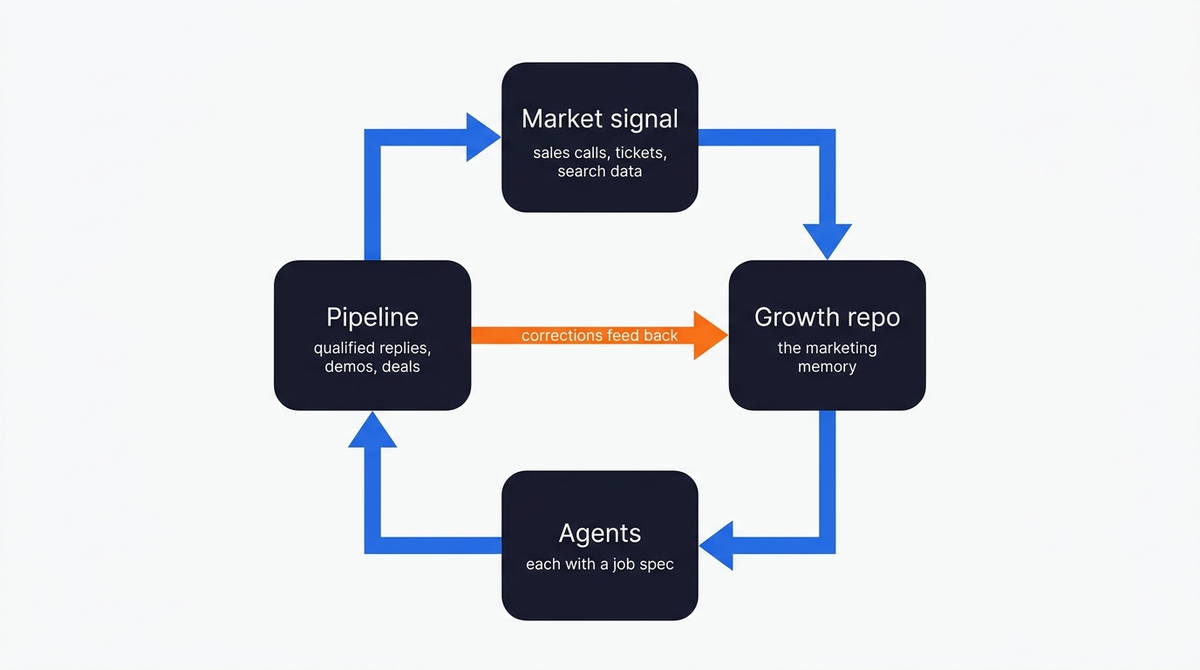
Greg Isenberg put out a video this morning about a job title that immediately resonated with me: the marketing engineer. He reckons it will become one of the most valuable hires in tech over the next two years - a $250,000-to-$1M role…. New job titles in this industry come, then go, then get forgotten - but the job he goes on to describe is one I recognise. It's how I've been working for the past year. I’ve just never really gave it a proper name.
His definition: “a marketing engineer turns market signal into pipeline using AI agents, data, code and taste.” In plainer terms, it's someone who still does the classic marketing work - understanding customers, positioning a product, getting it in front of people - but who also builds machinery behind it: the AI agents (software that pursues a goal through actions, rather than waiting for your next prompt) that watch the market, the data feeds that keep them correct, and the small tools that turn what they find into leads, research, opportunities, new ideas and so on.
Whether the title sticks is an early question, and I'll get to the sceptics in a moment. The job though is quite real, though. I run these systems every week at Houtini, and I'll show you them as we go - this then, makes me a Marketing Engineer.
Quick Navigation
Where it came from |
The growth repo |
Agent job specs |
In production |
Is the role real? |
Do you need one?
Where did this role come from?
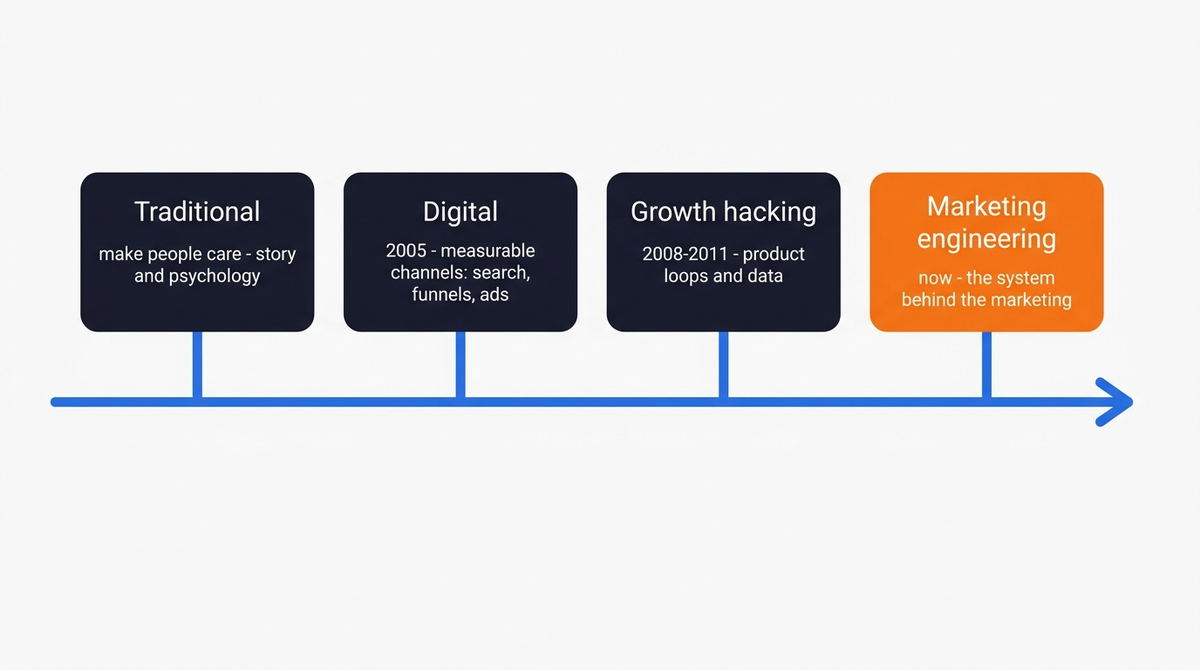
Isenberg's framing for where the role comes from is a tidy bit of history. Every big technology shift has minted a new most-valuable-marketer. The traditional era was the Don Draper business: make people care through story and psychology, on the medium available at that time. Then, the internet came along and created the digital marketer - leading us to funnels, organic search, ads and analytics, making the best marketers the ones who could acquire customers through channels they could measure and report on (thus proving the ROI of the work).
Then around 2008-2011 the growth hacker arrived, pulling marketing inside the product itself (this is the era that gave us Dave McClure's AARRR "pirate metrics" - acquisition, activation, retention, referral, revenue - which still turn up in pitch decks today).
I lived through a fair bit of all of that, given I've been in search marketing since the mid-2000s, and the pattern Gregg describes rings true: each shift looked optional (“wow that’s interesting, i’ll take a look later”) right up until it wasn't, and the people who moved early were unreasonably valuable for a sweet adoption curve until everyone else caught up and commoditized it.
This “agentic shift” is another epoch: The marketing engineer keeps all the old skills - positioning, customer understanding, distribution, taste - and adds the new part: they build the systems behind the marketing, the data collection, the analysis, the pattern matching and, while we work a properly optimised, continuously improving system keeps learning.
Start with the growth repo
The first thing Isenberg says a marketing engineer builds is the thing I'd most encourage you to steal, whether or not you ever use the job title. He calls it the growth repo: a GitHub repository (or just a structured folder, if the word "repo" brings you out in hives) that holds the company's marketing memory.
Most teams use AI in scattered, one-off chats. Someone asks ChatGPT for ten LinkedIn posts, copies out the one they like, and closes the tab. The work disappears. Next week the AI starts from scratch, knowing nothing about your customers, your voice, or what worked last time - when what it needed was the performance data, the objections from last month's sales calls, and the exact language that got replies. Every week the team pays for the same context twice.
The repo (my term is growth directory) fixes that by writing the context down where the agents can read it: a customer-truth folder (sales-call notes, support tickets, churn notes), a content folder (the founder's voice guide, hooks that performed), an outbound folder (who you sell to, what triggers a good moment to reach out, and the phrases your AI is banned from using - AI outbound gets weird fast if you don't fence it), a testing folder, and a folder of agent job specs. The prompt then changes shape entirely. Instead of "write me ten LinkedIn posts" it becomes "read the customer-truth file, read the voice file, read the five posts that drove qualified replies, and draft five more around pains buyers mentioned this week."
I built a version of this pattern before I'd heard anyone name it - I wrote up the approach in a piece on building a content research index for Claude. The principle is the same one: your accumulated judgement, written down, is what turns a general-purpose model into something that works for your company. Today, as an example - I use a very similar approach to keep an index of emails per client - in a local repo (local only obviously) with an index so that if I need to know who said what, when and teh agreed spec - that’s just an ask away.
Every agent gets a job description
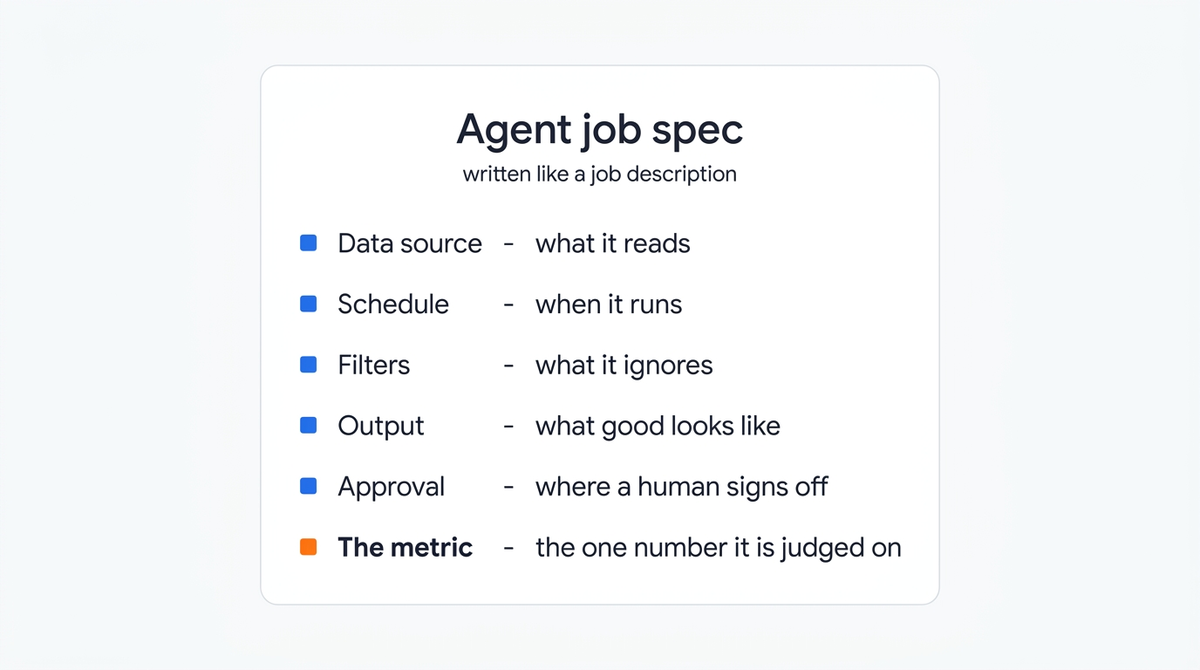
The other idea from the video worth taking seriously is the discipline around agents. Every agent gets a written job spec, the way a new hire might: the data source it reads, when it runs, what it filters out, what its output should look like, and which steps need a human sign-off.
The spec ends with the metric the agent is judged on: messages sent is activity; qualified replies from the right accounts is signal. An agent judged on activity will happily generate an impressive volume of nothing. Pipeline (the total value of deals in progress, for anyone outside the sales world) is the number a marketing engineer answers to, and everything upstream is arranged to serve it.
You then train the agent the way you'd train that new hire: small tasks, watch it work, correct the mistakes, and put each correction into the repo so it never makes that mistake again. The corrections are the compounding part. A chat session forgets your feedback the moment it ends; a repo doesn't. As an aside I’ve found this process is made more valuable by asking Fable to review the agent and supporting scripts and files to review for conflicting instructions - give that a go and prepare to be a bit shocked. Removing conflicts makes a massive difference!
The last piece is live data, because the difference between a fictional toy and a working production system is whether the agent can see the business. His example is SEO content: the beginner asks an AI to write a blog post about a keyword, while the marketing engineer's agent checks Search Console first, ranks opportunities by intent, checks the CMS for what already exists, goes off and does the research, then drafts with the founder's point of view in his/her tone of voice and sends the result for approval. That wiring is what MCP (Model Context Protocol - the standard for connecting Claude to your real tools) exists for; we've written a walkthrough of connecting Search Console to Claude if you want to see the shape of it.
What this looks like in production
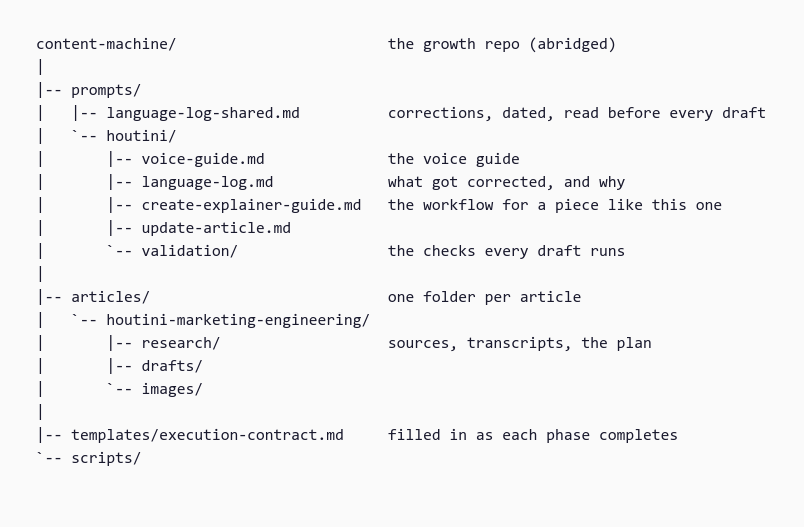
Houtini's content research operation runs out of a repository that looks a lot like Isenberg's growth repo, and it's been accumulating for over a year: a research folder for every article, a tone-of-voice guide (we built an MCP that measures one from a writer's corpus, because "sounds like us" should be something you can measure), and a dated correction log. When I correct a piece of work, the correction goes in the log with the date and the reason, and everything afterwards is checked against it. That's the "every correction becomes part of the operating system" loop from the video, running in production.
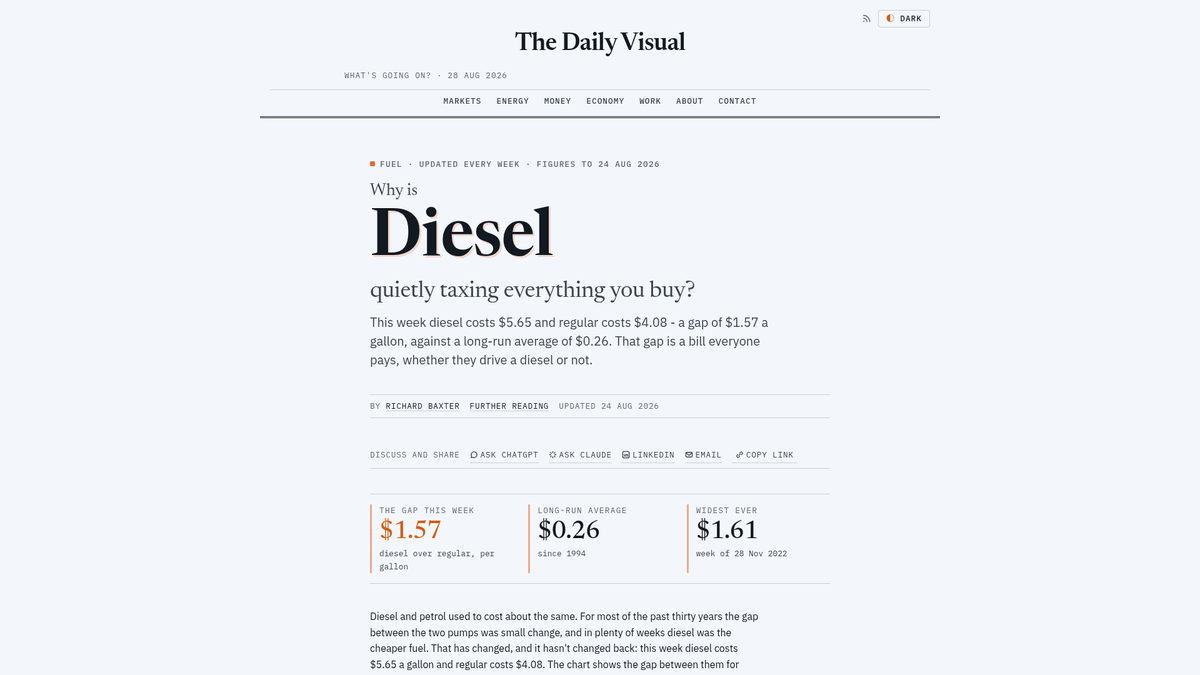
The most complete example is TheDailyVisual, a data-journalism site I threw together for fun. There are ~20 pages on the site, each pulling its figures from source APIs so the numbers refresh without anyone touching the page, and a scheduled morning routine verifies every source is fresh, fixes what's mechanical, and flags anything needing an editorial decision. One person oversees the whole thing, me. I wrote up how the continuously-updating content works if you want the detail.
And the “signal side” earns its keep well. This week I noticed something odd in houtini.com's traffic, synced Search Console into our SEO audit tooling, and had the answer inside a few minutes: one page cluster sliding down the rankings as a wave of fresh competitor content landed, with everyone else steady. Five years ago that diagnosis was a day of spreadsheet archaeology. The same wiring watches how visible we are in AI search - the ChatGPT-and-friends visibility that Isenberg lists as one of his six systems, and the one I'd say most companies are panic buying “Answer engine optimisation” hoping this new problem is solved.
For what it's worth, no first time project runs smoothly out of the box - which is why your corrections are so valuable and should be saved. My correction logs exists because early output is, these days, excellent (nothing like 2 years ago) and, and my morning routine exists because data sources update.
Is the role real?
A week before Isenberg's video, Grippi Media published a sharp piece after manually auditing LinkedIn's job listings, and found no evidence that marketing-engineer roles are booming - mostly contract gigs with wildly inconsistent descriptions, some not mentioning AI at all. I’m afraid this feels all too familiar - I just don;t think most SMEs are even remotely understanding what AI is capable of). Their stronger claim: the term is being manufactured by vendors, notably Profound (who publish a "Marketing Engineer Manifesto" and run a job board for the title), following the playbook Clay used to mint the "GTM engineer" title in 2023. Coin the role, sell the tooling for it to people who could easily build the system around themselves rather than adapting to, and getting hooked on, 3rd party saas.
Both things can be true, and I think (with my cynical hat on) the title is being pushed by people with something to sell, but, the job is turning up anyway, mostly under other names. The GTM-engineer role has proper data behind it: a 2025 Bloomberry analysis of over a thousand postings found 205% year-on-year growth (GTM engineer and RevOps postings combined) with a median posted salary of $127,500. Profound's own marketing-engineer listing offers $135,000-$200,000. Cognition, the company behind the Devin coding agent, posted a "forward deployed marketer" role in August. The backdrop is that AI marketing use has gone from experiment to infrastructure - Jasper and Benchmarkit's 2026 survey of 1,400 marketers put team adoption at 91%, up from 63% a year earlier, and Salesforce's 2026 State of Marketing found 75% of marketers had adopted AI. When nine in ten teams use the tools, the differentiator stops being access and becomes the system - and somebody has to own the system, in-house, but it’s OK to bring in outside expertise to get you started (waves!).
Do you need one?
If you're running a company, I'd answer it this way: you almost certainly don't need to win a bidding war for someone calling themselves a marketing engineer. You do need someone who owns the marketing system - and that person may already work for you. The profile is a marketer with a builder's streak, or an ops person who understands the customers: someone curious enough to write an agent's job description and stubborn enough to keep feeding corrections back into the repo. What they need from you is sponsorship and room, which is the same argument I made in the piece for managing directors and CEOs, and it’s just as true here because marketing is where under-sponsored AI projects go to die quietly.
If you're the marketer wondering whether to become this person: I'd endorse Isenberg's starter plan. Create one folder with five files - customer-truth.md, voice.md, experiments.md, agent-jobs.md and what-the-market-is-telling-us.md. Paste in twenty real customer notes or call summaries. Then give an agent one job: tell me what's changed, show me the receipts, and suggest one test that could create pipeline this week. Build whatever that output points at. One working system beats five half-built ones, and the tooling to wire it up is covered in our guide to the best MCPs for content marketing. As an aside did you know dataforseo can serve review data on your competitors through their MCP?
Continue reading.
- ExplainerClaude Code Skills: What They Do and Which Ones to Use
- AI at WorkAI isn't taking the jobs, it's taking the boring bits
- How-to GuidesHow to Connect Claude to Shopify with MCP (Dev MCP and Storefront Catalog)
- Beginner's GuidesWhat is n8n? A Beginner's Guide to Workflows, Pricing and Self-Hosting
- How-to GuidesHow to Use AI for Market Research with Claude
- How-to Guidesn8n MCP: How to Connect Claude Code to n8n and Use Its API Safely