AI isn't taking the jobs, it's taking the boring bits
In today's post I'm looking at the AI jobs market through Anthropic's Economic Index and my own job board, and why the busywork is the part to hand over.
 Richard Baxter AI Ops & Marketing Engineer
 On this page
You've almost certainly been handed the headline by now, in the news, in your LinkedIn feed, and usually somewhere in the middle of a meeting about next year's budget.
The premise, of course - the idea we've all been told to be scared of - is AI taking our jobs. Well, the best type of AI-assisted output is when it's created with a domain expert in charge: somebody who already understands the topic, the code, the development environment, the science, whatever the application of AI is. What AI takes off that person's plate is the repetitive stuff, the work that looks the same every week and was always a candidate for a template.
So the useful question isn't "will it replace me?" It's "which parts of my week were always busywork?" That one you can answer, and the data has a fair amount to say about it.
What the "AI takes your job" story gets wrong
The replacement story assumes AI does good work on its own. In practice, the output is only as good as the person steering it. A developer who knows the codebase can ask for a change, read what comes back and spot the line that will break production on Friday afternoon. Someone who doesn't know the codebase gets something that compiles and looks plausible, which is a different thing entirely. The same goes for a scientist checking a model's reading of a paper, or a marketer checking whether a piece of copy says anything. AI amplifies whatever knowledge you bring to it, and the gaps come along too.
People can lose out here, though: if AI takes the repetitive part of a role, and the role was mostly repetitive, the role shrinks.
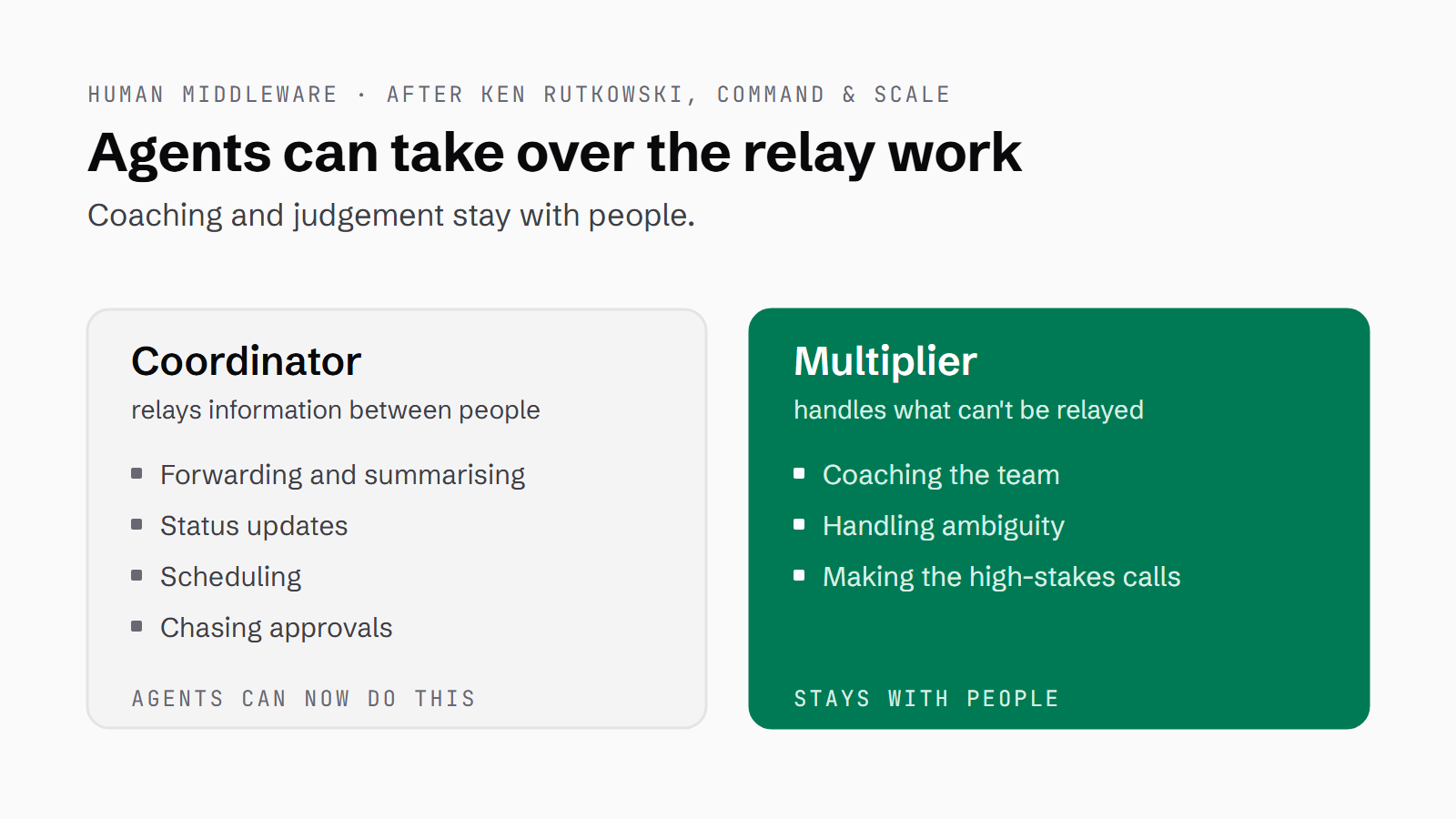
Ken Rutkowski names that exposed layer in "The End of Human Middleware", an essay he published on Command & Scale in May 2026. His argument is that a lot of management grew up around moving information between people and tools: status updates, summaries, scheduling, chasing approvals. Agents (AI systems that carry out multi-step tasks without someone prompting each step) can now do that relay work continuously and more cheaply. Rutkowski calls the people doing it human middleware, and he splits managers into Coordinators, who mostly relay, and Multipliers, who coach, handle ambiguity and make the high-stakes calls. In his words, "AI is not killing managers; it is weakening the economic need for human coordination at scale."
That frame travels well beyond management, to the relay part of any knowledge role: the forwarding, the status chasing, the diary full of meetings where nothing gets decided. Now if you're just forwarding emails and attending meetings back to back, you're in trouble, and it's time to re-acquire the skills that got you there. The expertise that earned you the seat is the part AI can't stand in for.
The work AI absorbs
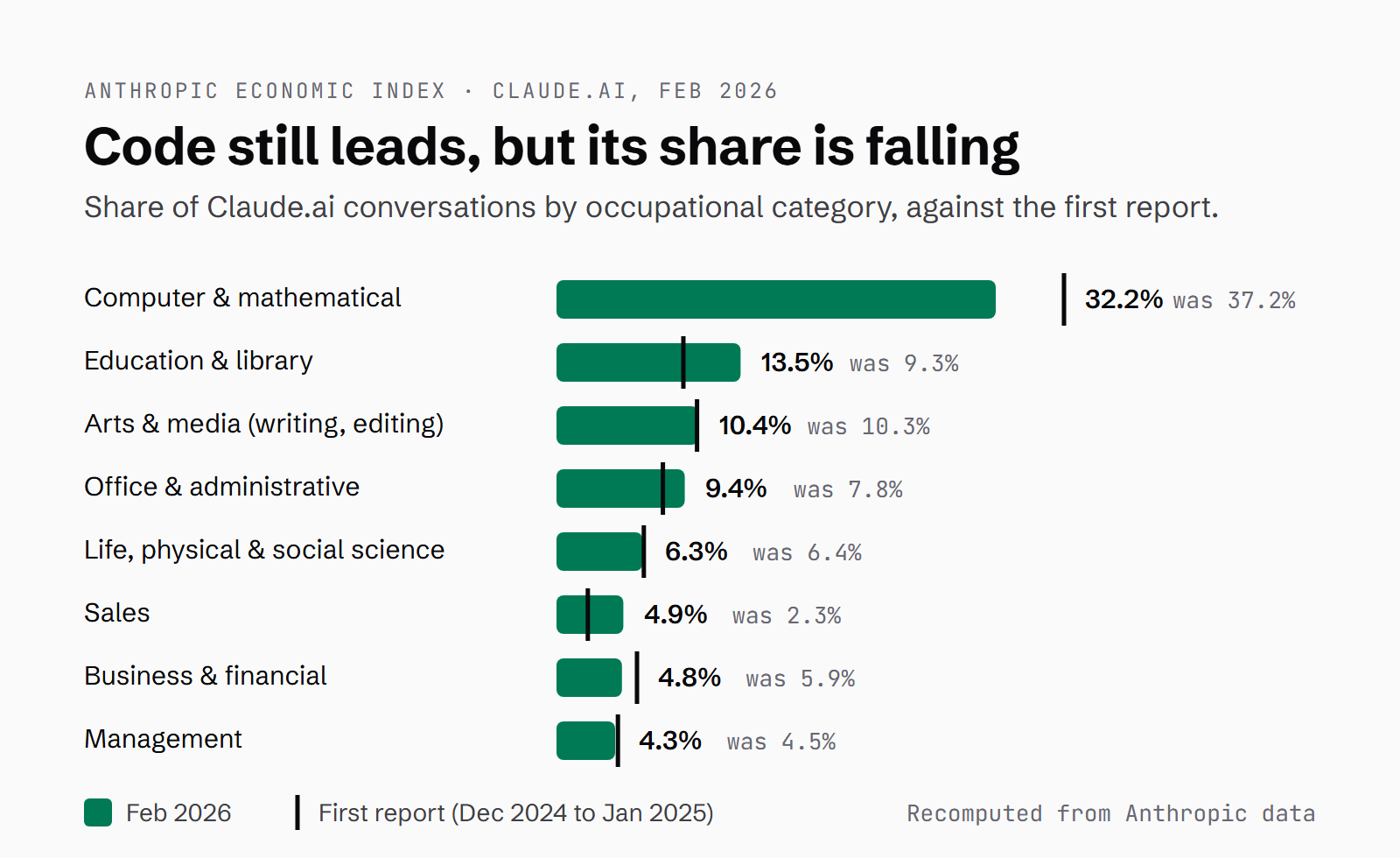
Anthropic publishes a running study of how people use Claude, called the Anthropic Economic Index. It maps anonymised Claude.ai conversations to O*NET, the US government's database of occupations and the tasks each one involves. The newest usage data is a single week of Claude.ai conversations from February 2026, published in Anthropic's March 2026 report. Code is still first by a distance, although on shares worked out from Anthropic's raw data, computer and mathematical tasks are down to 32.2%, from 37.2% in the first report a year earlier. Education is now second at 13.5%. Writing and editing, which Anthropic files under arts and media, sits third and has barely moved, at about 10%. Sales more than doubled, from 2.3% to 4.9%, and office and administrative work rose from 7.8% to 9.4%, so the use is spreading beyond code into the routine work that keeps a company ticking over.
I come from marketing, where most of the content work is writing and editing. A lot of marketing is highly commoditised, particularly the email side, outreach, link building and technical audits. Business owners trying their best to hold on to revenue look at that work and see efficiency gains.
At its core, outreach is a list of relevant sites, a contact at each one, and a first email tailored just enough to get read. Then there's the follow-up, and a log of who replied and who didn't. The tailoring changes from campaign to campaign, but the shape of the job barely moves. A technical audit is much the same: crawl the site, check the status codes, the canonical tags, the redirect chains, write it up, and do it again next quarter. A lot of people have highly repetitive tasks they do day in, day out, which they know are so similar that there's probably a way to templatise and automate this stuff.
What doesn't commoditise is the bit at either end of those jobs. Somebody still has to decide which sites are worth pitching in the first place, and what the brand should be saying when it gets there. Somebody has to read the audit and know which three findings matter to this business this quarter and which forty can wait.
Who the market is hiring
For the hiring side, I read the market off YubHub, the AI-enriched job board I built. As of 11 October 2026 it held 29,024 enriched jobs from 327 active feeds across 969 companies. As each listing arrives, an AI pipeline enriches it: it classifies the category, infers the experience level and tags whether the role is onsite, hybrid or remote. The board is a broad mirror of the labour market, so I've filtered it down to the knowledge-work categories that line up with the Economic Index: engineering, sales, operations, IT, finance, marketing and design.
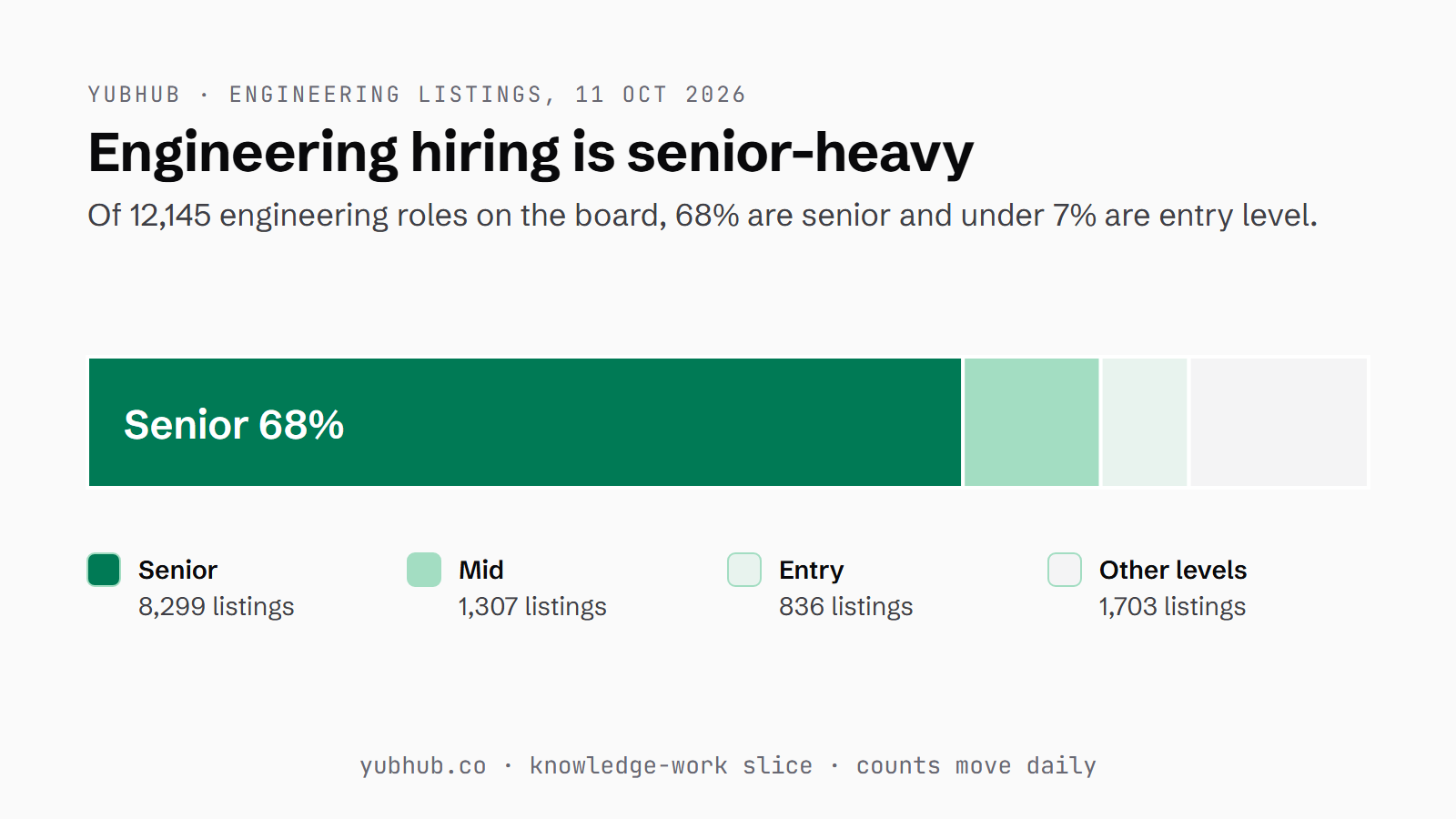
Engineering dominates that slice, with 12,145 listings on the board as of 11 October. It's also where the board puts AI roles. It does have a few AI categories, but they're tiny, because it classifies those roles as engineering, which is what they are. Of those 12,145 engineering roles, 8,299 are senior and 836 are entry level. That's roughly 68% senior and under 7% entry.
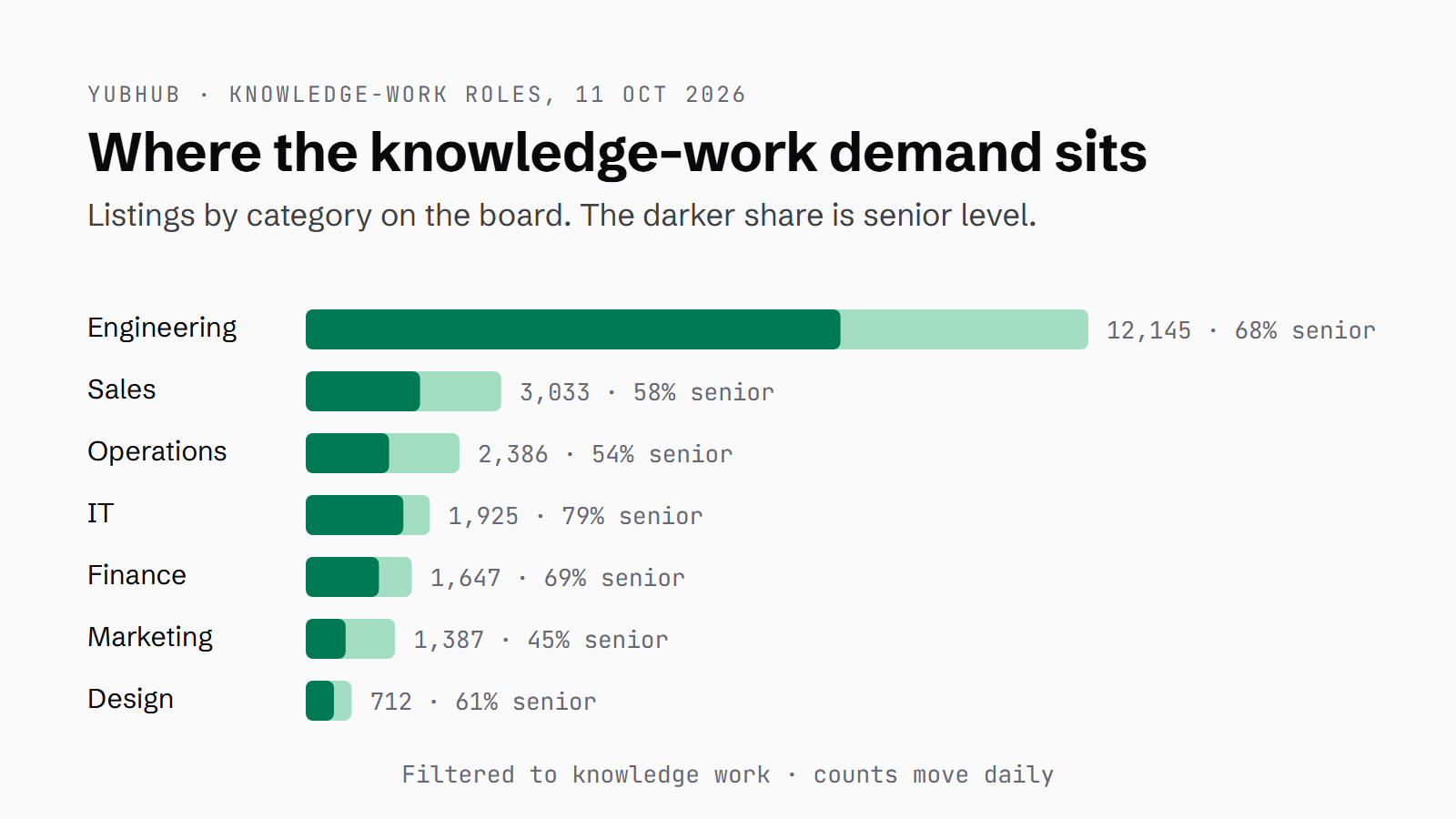
If AI were replacing expertise, you'd expect that ratio to tilt the other way, with cheap junior seats running the tools. Instead, the board shows companies hiring senior people, the kind you'd put in charge of the tools. In Rutkowski's terms, that looks to me like hiring demand for Multipliers. The same numbers have a less comfortable side, too: a narrow entry door means fewer places to learn the expertise in the first place, and the board can't tell you how that gets fixed.
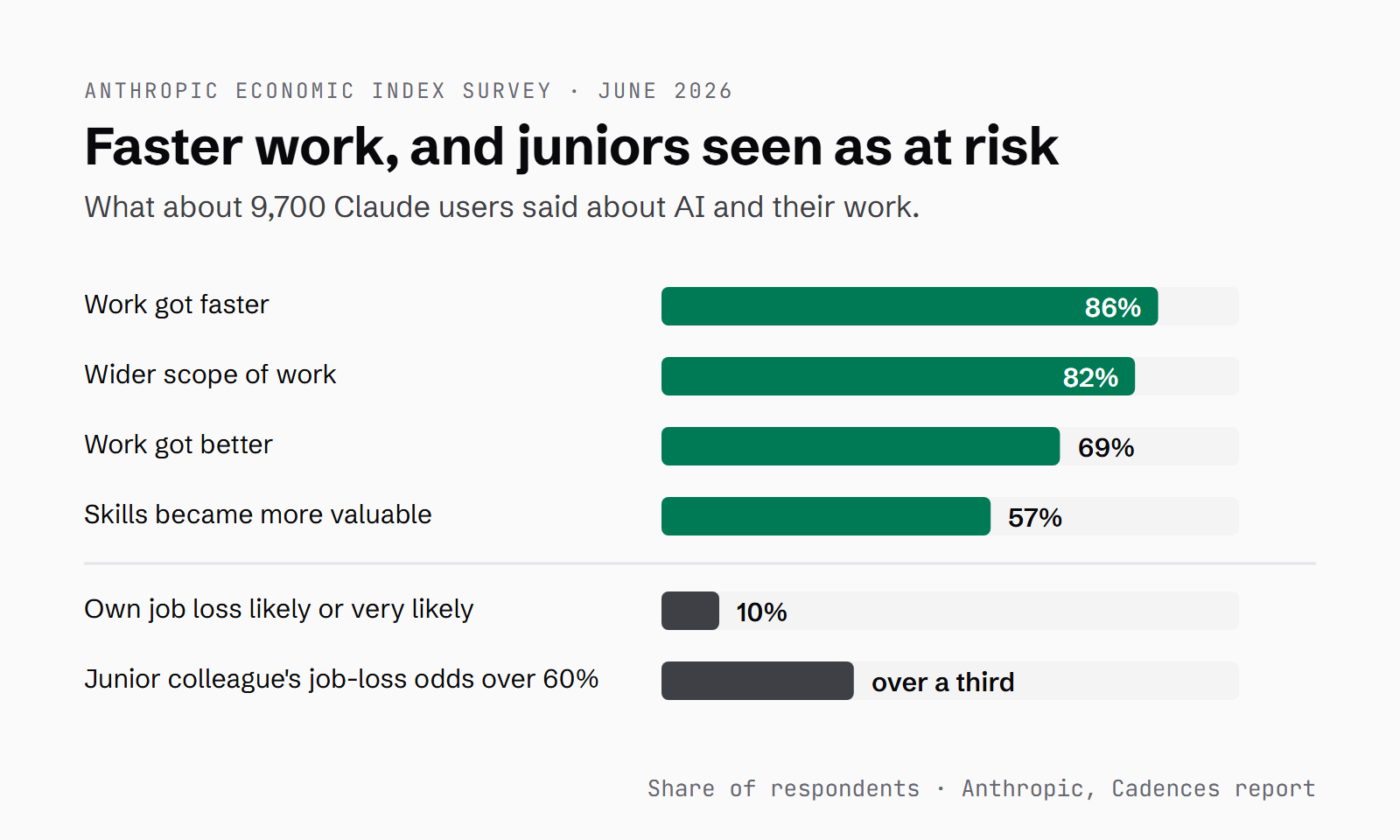
Anthropic has also asked Claude users how they see their own jobs, in its first Economic Index Survey. The survey launched in April 2026 and was reported in June, with about 9,700 people taking part. Of those, 86% said AI had made their work faster, and 57% said it had made their skills more valuable. Only 10% rated losing their own job as likely or very likely. Asked about a junior colleague instead, over a third put the odds of that colleague losing their job in the next year above 60%. That lines up with the narrow entry door on the board.
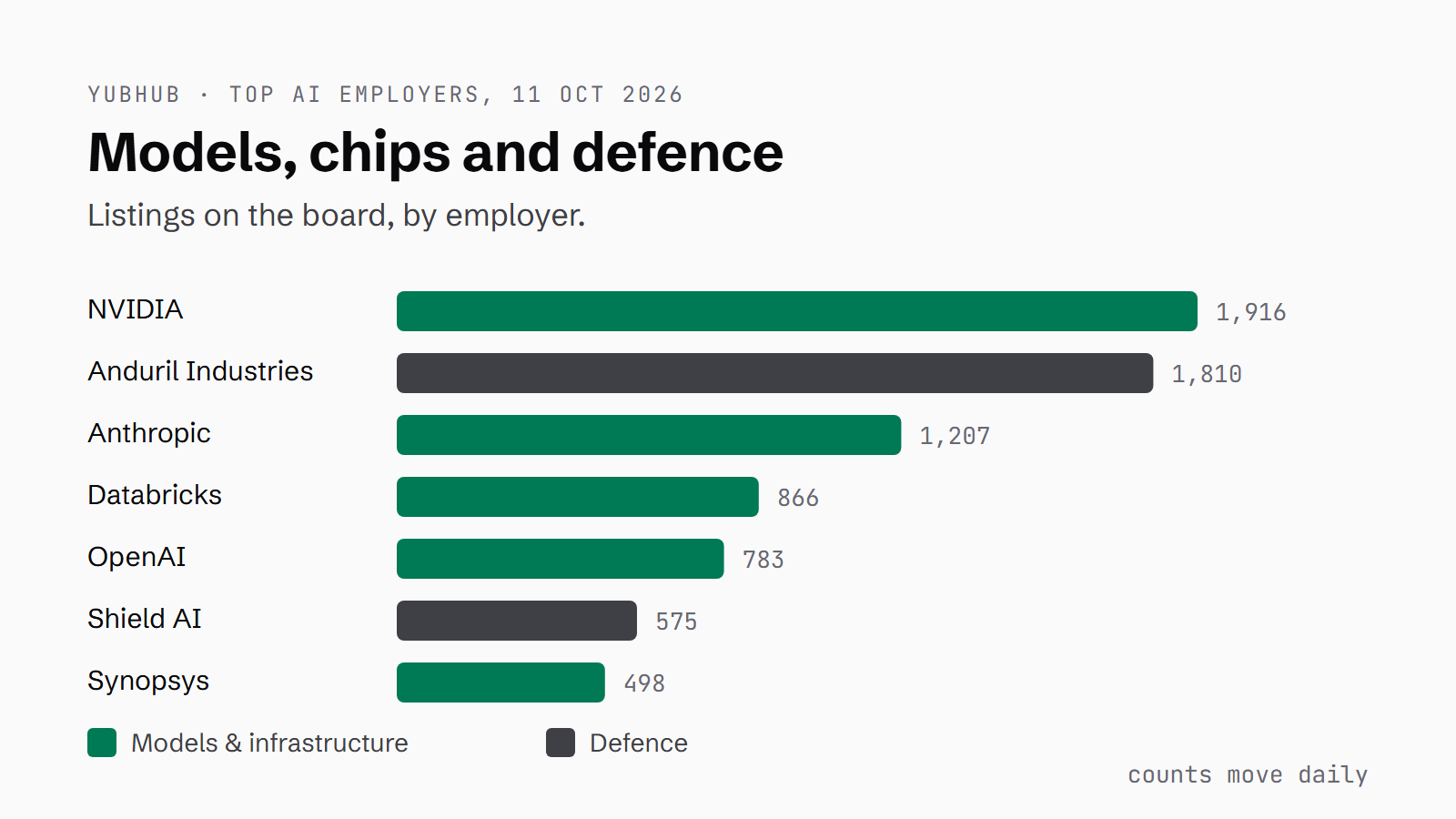
If you pick the AI employers out of the board's biggest hirers as of 11 October, most of them are building the models or the chips the models run on. NVIDIA has 1,916 listings, Anthropic has 1,207, Databricks 866 and OpenAI 783. Defence AI sits right alongside them, with Anduril Industries at 1,810 listings and Shield AI at 575, which makes defence one of the biggest AI employers on the board. Chip design is there too, with Synopsys at 498.
Several of the AI-native titles on the board as of 11 October are about deployment: there are 30 AI deployment strategists, 30 solutions architects, 26 forward deployed engineers and 24 deployment strategists. A forward deployed engineer works inside the customer's organisation, getting the product running against their real systems and data. These are small numbers next to 12,145 engineering roles, and the AI engineer title rose by just seven in the board's latest 14 days against the 14 before. The fastest riser over the same fortnight was senior software engineer, up 18.
What an efficiency gain buys a business
But an efficiency gain is not a bad thing at all. It's a more profitable company; it's a company that can do more with the skilled and talented people it has. And that's my view: there are areas that - do you know what? - human beings don't like doing. It's boring. And it gets in the way of the real work, which is the planning, the strategising, the thinking, and turning that output into direction.
A good chunk of a marketing team's week goes on the outreach list, the follow-up chase, the monthly report rebuilt from the same three dashboards, and the audit that flags the same redirect chains it flagged last quarter. None of that is why anyone hired them. They were hired for their judgement about the audience, the market and what to do next, and the busywork is what kept them from using it.
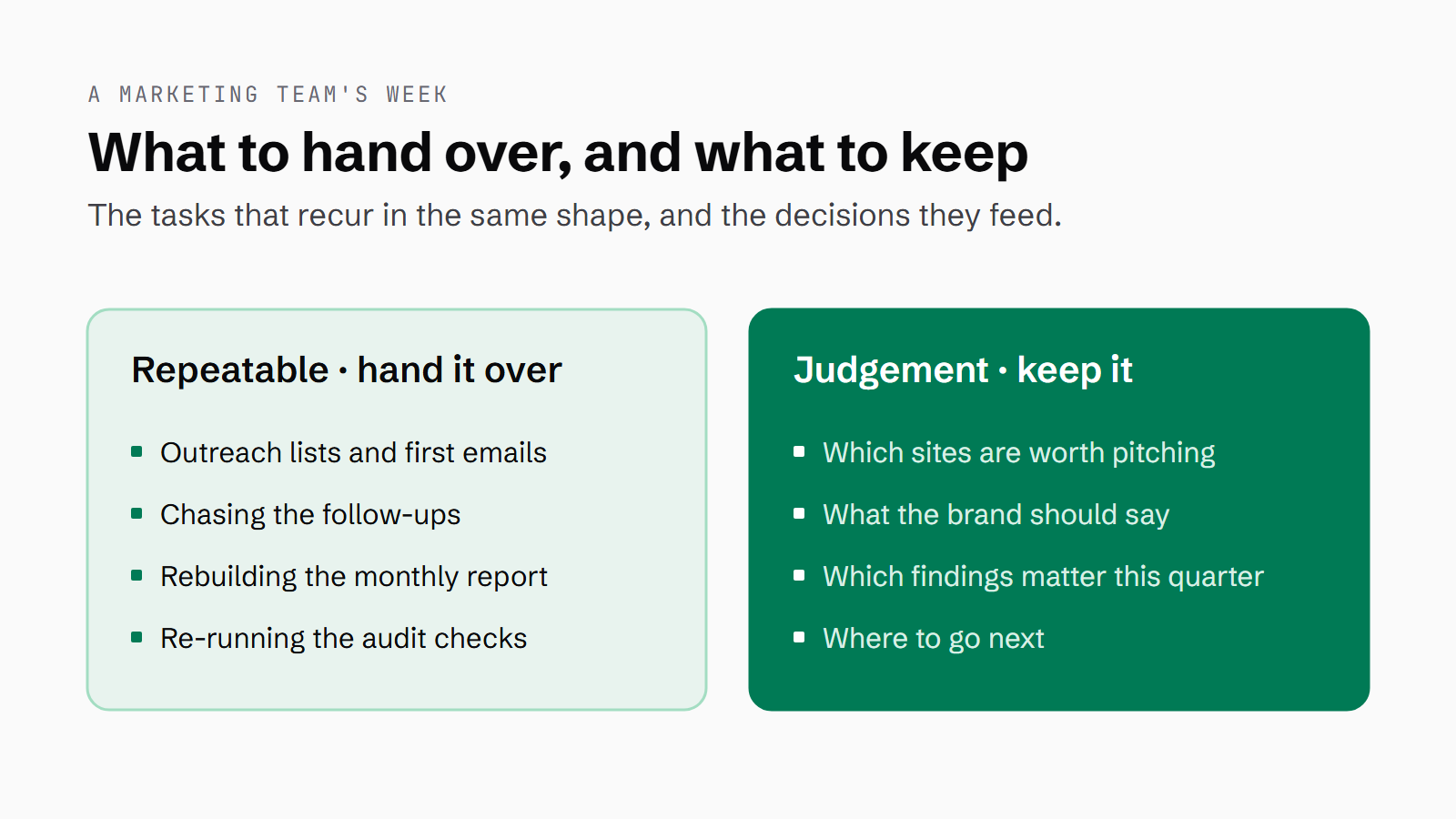
Hand that work over and the hours left go on the part that needs someone who knows the business: planning next quarter's campaigns against what worked last quarter, deciding which market to go after and which to leave alone for now, and reading a set of results well enough to turn them into a direction the rest of the team can act on.
The cynical reading is that a company needing fewer hours for the same output will simply employ fewer people. Sometimes it will. The board's skew points somewhere else, though: companies are hiring senior people, and the profitable move is to put more of those people's hours into the decisions that grow the business. A business doing more with the people it already has is in a far better position to keep them.
A team that used to spend Tuesday compiling a report can spend Tuesday deciding what the report means.
The figures in full
Claude.ai conversations by occupational category
| Occupational category | Dec 2024 to Jan 2025 (first report) | Nov 2025 | Feb 2026 |
|---|---|---|---|
| Computer and mathematical | 37.2% | 36.0% | 32.2% |
| Education and library | 9.3% | 16.2% | 13.5% |
| Arts, design and media (writing and editing) | 10.3% | 10.6% | 10.4% |
| Office and administrative support | 7.8% | 8.3% | 9.4% |
| Life, physical and social science | 6.4% | 5.8% | 6.3% |
| Sales | 2.3% | 3.2% | 4.9% |
| Business and financial operations | 5.9% | 3.4% | 4.8% |
| Management | 4.5% | 3.5% | 4.3% |
YubHub listings by experience level, 11 October 2026
| Category | Listings | Entry | Mid | Senior | Other levels | Senior share |
|---|---|---|---|---|---|---|
| Engineering | 12,145 | 836 | 1,307 | 8,299 | 1,703 | 68% |
| Sales | 3,033 | 280 | 314 | 1,773 | 666 | 58% |
| Operations | 2,386 | 266 | 340 | 1,293 | 487 | 54% |
| IT | 1,925 | 89 | 148 | 1,514 | 174 | 79% |
| Finance | 1,647 | 128 | 220 | 1,135 | 164 | 69% |
| Marketing | 1,387 | 368 | 106 | 618 | 295 | 45% |
| Design | 712 | 82 | 101 | 437 | 92 | 61% |
What this data can and can't tell you
YubHub is a live sample, not a census. Its 29,024 enriched jobs as of 11 October come from the 327 feeds I've chosen to ingest, so the mix reflects those choices as much as the wider market. That's why I've kept to the knowledge-work slice. The classification is AI-inferred, too: the pipeline sets the category and experience level on each listing from the wording of the advert.
For all the board's limits, its category and seniority numbers only exist because it's AI-enriched. A human-curated board can list jobs, but it can't consistently tag the category, seniority and working arrangement of nearly 30,000 of them as they arrive. That enrichment is an AI doing exactly the kind of repetitive classification work a person would otherwise do by hand.
The Economic Index conversation data tells you which tasks people bring to Claude, not whether the work got any better or whether anyone's job changed as a result. It also only covers people using Claude. Anthropic hasn't published a full table of category shares since its January 2026 report, so the shares here are worked out from the raw data it releases, using the method in its own analysis code. That method reproduces the figures in the first report and in the January 2026 report. Anthropic's March report puts code at 35% for the same week, against the 32.2% this method gives, and without the report's own table there's no way to see where the difference comes from. The survey is self-reported, and it leans towards computer and maths workers, who make up about 30% of respondents.
Find the busywork, keep the judgement
If you're the domain expert, write down the parts of your week that were always busywork - the report you rebuild every month, the emails you send in the same shape, the audit checks you could run in your sleep. Hand them over one at a time, and check what comes back the way you'd check a new starter's work. If you run the business, ask for the same list from each person on the team, and ask what they'd do with the hours back. The live dashboard tracks the board's numbers as they move, and the hiring companion covers who to bring in next. Then open your sent folder and start with the email you send most often.
Continue reading.
- AI at WorkWhich AI is right for your job? ChatGPT, Claude, Gemini and Copilot, task by task
- How-to GuidesHow to Connect Claude to Shopify with MCP (Dev MCP and Storefront Catalog)
- Beginner's GuidesWhat is n8n? A Beginner's Guide to Workflows, Pricing and Self-Hosting
- How-to GuidesHow to Use AI for Market Research with Claude
- How-to Guidesn8n MCP: How to Connect Claude Code to n8n and Use Its API Safely
- How-to GuidesHow to Run Qwen3-Coder-Next Locally: My vLLM Settings for Two 48GB RTX 4090s