Claude for Excel Review (2026): What Works, What Bites & Prompts to Steal
In today's post we're taking a proper look at Claude for Excel - my hands-on review from a real product data audit, the permission default that still bites, and the prompts I keep coming back to.

Need to use Claude in Excel? You've got the spreadsheet. You've got the data. You probably know exactly what you want it to do. Who wants to spend an hour figuring out which formula syntax Claude understands, what its limits are when the workbook gets messy, and whether it's any better than Copilot at the things that take you all day?
This is that hour, compressed. I first tested Claude for Excel on launch day, against a real PIM product data audit, back when it was still in beta. Three months on, the product is generally available, it's part of a bigger suite, and several of the things I complained about have been fixed.
I'm very bullish on the importance of implementing AI tool use in the workplace, and Anthropic agrees.

Anthropic announced their Excel plugin in February 2026 and shipped it to General Availability on May 7, 2026 . On launch day I tested it against a real PIM product data audit to see how it worked, whether it was any good, and whether I'd trust it in a live workflow. Here's how I got on.
Quick Navigation
What's changed |
The suite |
Putting it to work |
Time saved |
The audit prompt |
Everyday prompts |
The workbook |
Tips |
Verdict |
Connectors
What's changed since launch
Four things have moved since launch day:
- It's GA now. Claude for Excel exited beta on May 7, 2026, alongside Claude for PowerPoint and Claude for Word. The "proceed with caution because this is Beta" framing in my original verdict no longer applies. Claude for Outlook is still in public beta on all paid plans.
- The session-persistence problem has been fixed. Conversations are now tied to the file. Close the sidebar or the workbook, reopen it the next day, and the history is still there. This was my biggest complaint in February. It's resolved.
- Microsoft 365 Copilot customers can now use Claude as a model choice inside Copilot for Excel and PowerPoint. They're not just rival add-ins any more - you can run Claude through the Copilot sidebar if you're already paying for that.
- Connectors and Skills have landed. Back in February I signed off wishing for MCP support; Anthropic have granted it, and there's a whole section on what that unlocks at the end.
Before the audit, a bit of context on the suite it now belongs to.
What you get across the suite now
The Microsoft 365 integration now covers four apps, with shared context across all of them:
- Claude for Excel (GA) - what this article is about. Ask about any cell, update assumptions without breaking formulas, build models from scratch.
- Claude for PowerPoint (GA) - build slides in your template, edit selections, generate charts and diagrams.
- Claude for Word (GA) - edit with tracked changes, respond to comment threads, write using company styles.
- Claude for Outlook (Beta) - triage your inbox, draft replies that wait for your approval, find time across calendars.
One conversation carries between all four. Adjust an assumption in Excel, the chart in PowerPoint updates, the number in your Word memo updates. The cross-app context is the bigger product story; the rest of this article stays focused on Excel.
If you've seen both names and wondered: Claude for Excel is one app inside the Claude for Microsoft 365 suite - the same add-in, one AppSource listing.
Two smaller additions have arrived since launch, too. The sidebar now has a model picker (a curated subset of the Claude line-up - what appears depends on your organisation's model access settings), and you can dictate to Claude in the sidebar rather than type.
Installation
You install the connector through the Microsoft AppSource Marketplace . The single listing covers Excel, PowerPoint, and Word; Outlook is a separate listing . You'll need to sign in with your Microsoft account.
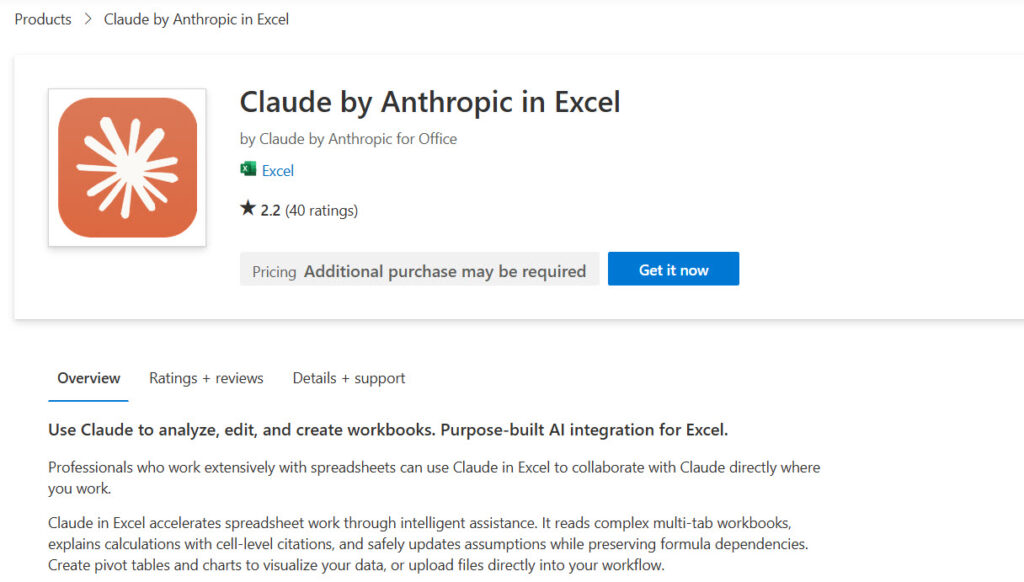
Click Open in Excel. A pane opens automatically. Connect to Anthropic from there. Straightforward.
If you open a new spreadsheet later, just hit the Claude button in the toolbar. Subscription-wise, Claude for Microsoft 365 is available on all paid Claude plans (Pro, Max, Team, Enterprise) and via Microsoft Foundry, Amazon Bedrock, or Google Cloud Vertex AI for enterprise customers routing through their existing LLM gateway.
New to Claude? New accounts get a free week of Claude Code , and the same Pro or Max plan is what unlocks Claude for Excel.
Putting it to work
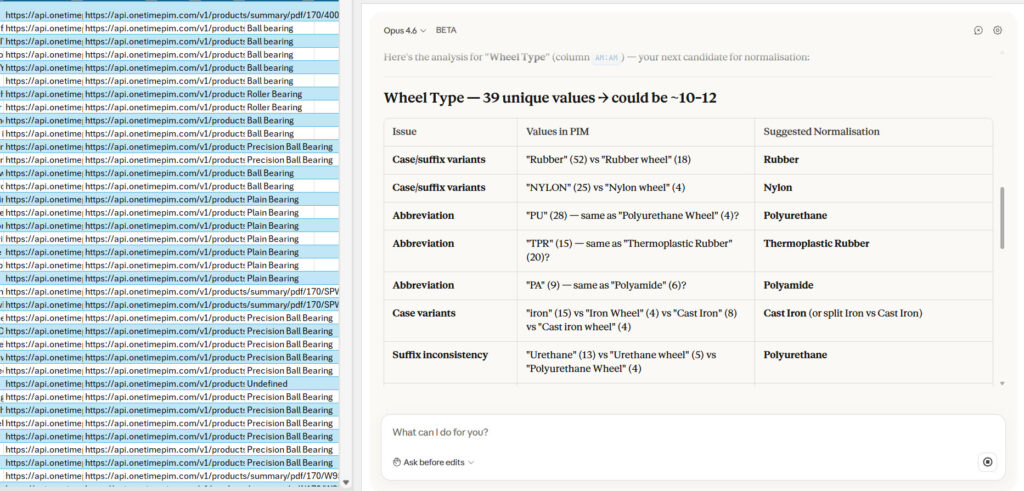
I'm currently auditing a large PIM product data spreadsheet with a huge number of product attributes. I'd already audited the file manually, so I was armed with a solid context to analyse how close and how accurate Claude's approach to the data might be. I created a new, unaudited version to spot the difference.
Where it was good (and still is)
Claude correctly identified a group of columns with very inconsistent data naming. That was the reason I was auditing the data in the first place, so we were off to a decent start. It gave me a clear list of columns to investigate. Off I went to correct them.
One thing worth highlighting in the workflow: when you ask Claude questions about specific cells or formulas, it will provide answers with cell references when that's useful. The citations are clickable, so you can head straight to the intended destination. For a large workbook with multiple tabs that's very helpful. You're not left guessing or scrolling.
It handled my fairly large data set without any performance issues. No crashes, no timeouts. Copilot in Excel has a bit of a reputation for struggling with longer spreadsheets and royally screwing your data up, so this was good. The accuracy held throughout - as I checked each answer, Claude got a 10/10 for the audit work itself.
Claude inside Copilot
Since launch, Microsoft 365 Copilot customers can use Claude as the underlying model inside Copilot for Excel and PowerPoint. If you're already paying for Copilot, you don't have to abandon it - you can switch the model to Claude for the kinds of tasks where Claude pulls ahead. The comparison is no longer "Claude vs Copilot." It's "which model is doing the work inside whichever sidebar you happen to be using."
Where it was less good
Claude was a little too keen to make changes directly, without asking permission first. When you're working in Claude Desktop or Claude Code, Sonnet and Opus will ask you if it's ok to allow MCP access for a particular service. The same instinct didn't transfer to Excel by default.
There's a fix, and I missed it on first run. Anthropic's documentation describes an overwrite protection feature, and an "Ask Before Edits" mode that you have to toggle on via the document icon in the sidebar. As of September 2026 this is still opt-in, not the default. The feature exists, you can enable it, and you should as the first step of any workflow that touches real data. The default behaviour is still my one substantive complaint about the product.
As an aside, and unlike Copilot in Excel, Claude doesn't require you to enable auto-save (although mine is on anyway). Your files don't need to live in OneDrive, which means a huge number of people can use the connector who wouldn't otherwise.
The chat history problem (now fixed)
In February, my chat history wasn't saved between sessions. Close Excel or restart, and your conversation with Claude was gone, even if you were mid-audit.
As of the May 7 GA release, this is no longer the case. From Anthropic's announcement :
Conversations persist with each file, so you can close the sidebar, reopen it the next day, and pick up where you left off using your keyboard or your voice.
The session-logging option in settings (the "Claude Log" tab that tracks actions taken each turn) is still there as an audit trail. Between the two - persisted conversation plus a turn-by-turn log - I'm now confident letting Claude work on a spreadsheet without losing the thread when I close it. One nuance worth knowing: the history is stored locally in your browser, so it stays with the machine rather than following your Claude account between devices. This was a beta problem. It got solved.
The chart: time saved across the three workflows
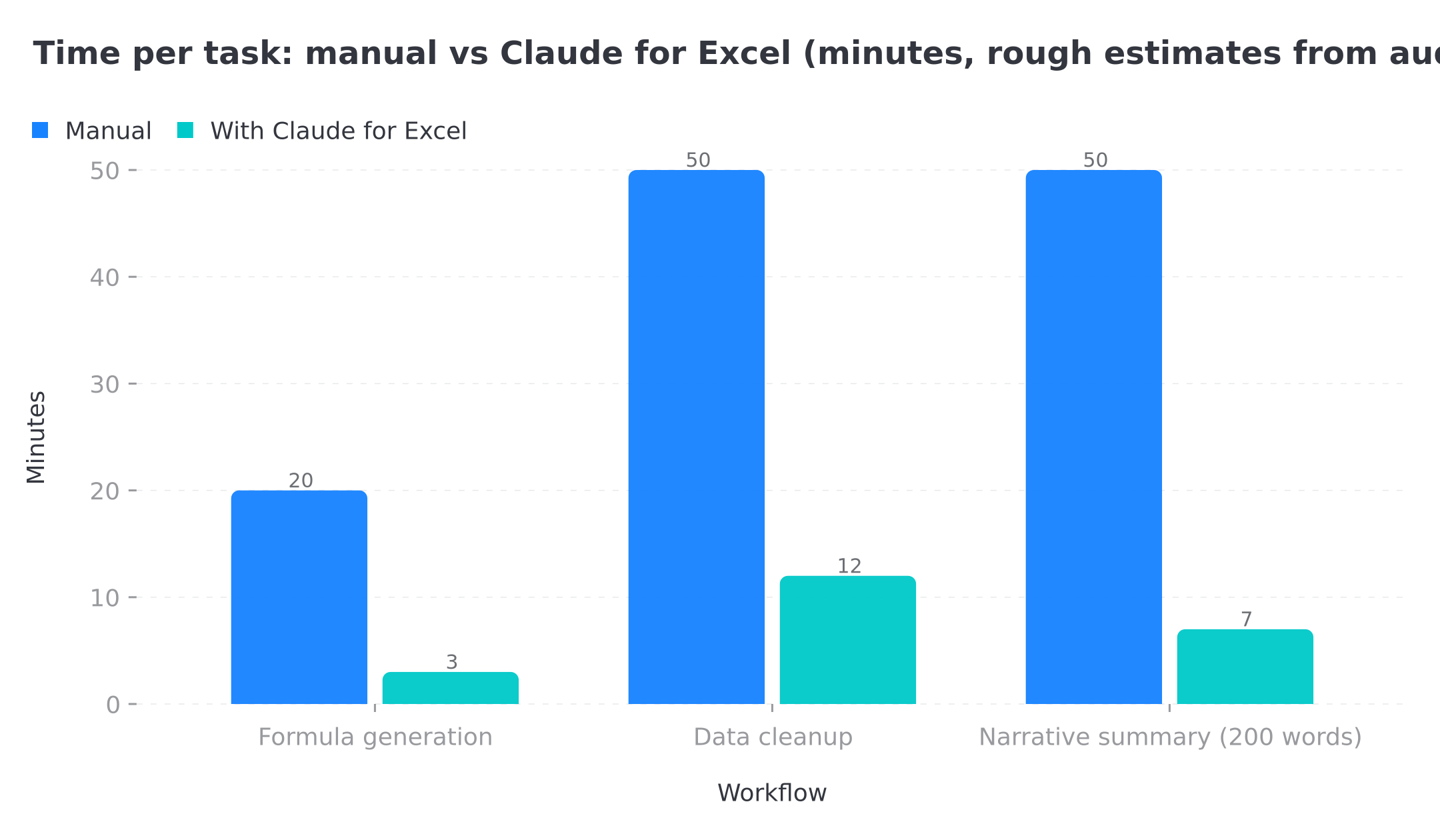
Rough time estimates from audit testing - your mileage will vary depending on the size of the workbook and how cleanly the source data is structured. The pattern holds: it's the cleanup-and-narrative workflows where the time saved compounds, not the one-off formula questions.
A useful prompt for data audits
If you're running a similar audit, this is the prompt I keep coming back to. It does most of the work. The bit that matters is the column descriptions in plain English - Claude doesn't see your workbook with the intuition you have about what each column means. Telling it explicitly turns 60% of formula generation from "wrong type, wrong direction" into "right first time."
You are working in this Excel workbook on the sheet "[sheet name]".
The data range is [A1:F500] with these columns:
  A: [column name + what it actually contains]
  B: [column name + what it actually contains]
  ...

Task: [one sentence on what you want Claude to do - e.g. "find columns with
inconsistent naming and flag them for review"]

Return:
1. The answer, with cell references where useful.
2. A short explanation of how you got there.
3. A note on which rows or values might cause problems (empty cells, text where
   numbers should be, dates in mixed formats - whatever applies to this data).

Important: do not edit any cells without asking me first. If you think a change
is needed, describe it and wait for my confirmation.
That last paragraph is the workaround for the default-permissions problem. Until "Ask Before Edits" mode is the default, including the explicit "wait for my confirmation" line in the prompt is the most reliable way to stop Claude from running ahead.
Prompts for everyday Excel jobs
The audit prompt above is the heavy one. Most days the job is smaller: a lookup that keeps breaking, a column of #N/A errors, a supplier list someone has typed six different ways. The useful shift with Claude for Excel is that you stop writing the formula and start describing the outcome. You tell it what you want and what is going wrong, and it writes the VLOOKUP (or, more often, the XLOOKUP). These are the ones I reach for most. Each keeps a "check with me before you change anything" line, because Ask Before Edits still isn't the default.
Pulling a value across from another sheet. The everyday lookup, without touching the syntax.
In column E, pull the supplier name from the "Suppliers" tab by matching the SKU
in column A. Where a SKU has no match, write "no supplier on file" instead of
leaving an error. Show me the formula you used, and check with me before you
fill the column.
Fixing a column of #N/A. A lookup returns #N/A for a few reasons: trailing spaces on one side of the match, numbers stored as text on one side and real numbers on the other, an approximate-match flag where you needed an exact one, or a value that isn't in the source at all. You don't have to work out which. Describe the symptom and let Claude diagnose it.
Column F is full of #N/A from a lookup. Work out why each one is failing -
trailing spaces, numbers stored as text, an approximate match, or a value that
isn't in the source - and fix the ones caused by formatting. List the ones with
no match in the source so I can chase them. Don't change anything until you've
shown me the list.
Standardising a messy column. The names-typed-six-ways problem.
Column C has company names entered inconsistently - extra spaces, mixed
capitalisation, "Ltd" in some rows and "Limited" in others. Standardise them to
one consistent format. Show me a before-and-after for everything you'd change
and wait for my go-ahead before applying it.
Understanding a formula you inherited. Before you trust it, or rip it out.
Explain what the formula in cell H2 does in plain English. Tell me where it
could break - empty cells, text where it expects numbers, a moved column - and
suggest a more robust version if there is one.
Summarising without building the pivot by hand. Straight to the answer, with the method shown.
From the data in A1:F500, give me total revenue by region and by month. Tell me
whether you used a pivot table or formulas, and how you set it up, so I can
rebuild it myself next time.
Finding duplicates that aren't identical. Same key, conflicting rows.
Rows in this sheet are duplicated on the SKU in column A, but the other columns
don't always agree. Find the duplicate SKUs, show me each conflicting set side
by side, and recommend which row to keep. Don't delete anything until I confirm.
Splitting one column into several. Text-to-columns, described not clicked.
Column B holds full names as "Surname, Firstname". Split them into two new
columns, Firstname and Surname. Flag any rows that don't fit that pattern
instead of guessing.
None of these need you to remember whether it's VLOOKUP, XLOOKUP or INDEX/MATCH. That's the point. The one habit worth keeping is the confirmation line at the end of each prompt: until Ask Before Edits is on by default, that line is what stops a clever fix from quietly rewriting a column you needed. The workbook below has these baked into sample tabs, so you can watch each one run before you let anything near live data.
The downloadable workbook
I've built a companion workbook that exercises this prompt across three workflows: formula generation against an inventory dataset, data cleanup on a deliberately messy export, and narrative summary from twelve months of revenue data. Five tabs, sample data, the prompts baked in, MIT-licensed.
Download claude-for-excel-workflows.xlsx (15KB, MIT-licensed)
The workbook is the artefact. The prompts are the recipe. Fork it, adapt the column names, point it at your real data.
Tips worth knowing
A few things that make Claude for Excel behave - some learned at the keyboard, some lifted from people who've pushed it harder than I have.
Give it a house style once
In Settings, under Instructions, you can set standing guidance that applies to every conversation in Excel - number formats, how you like formulas written, a tone for the explanations. Kevin Stratvert and Kenji Explains both lean on this in their walkthroughs, and Anthropic's own guide points to it: set it once and every request inherits it.
Watch your usage limits
File work burns through your plan's limits faster than ordinary chat does - Josh Aharonoff, who has been testing the add-in on real financial models all year, calls credits the thing everyone is complaining about. On Pro you can max out mid-model; if Excel is going to be a daily surface for you, that's the argument for the Max plan.
Make it colour-code as it works
This one's from Kenji Explains and it's a keeper: add a standing instruction to colour inputs blue, formulas black, and cross-sheet links green. You end up with a model you can audit at a glance, which matters the moment someone else has to trust the numbers.
Let Claude write the prompt first
Another Aharonoff habit worth stealing: before you touch the sidebar, describe the task to Claude in an ordinary chat and ask it to write the best prompt for the job, then paste that into Claude for Excel. It sounds like a faff, and it consistently beats the prompt you'd have typed off the cuff.
Only point it at workbooks you trust
The official guide is blunt about this, and it's the tip I'd least want you to skip: a spreadsheet is a document, and a downloaded template or a vendor file can carry instructions hidden in a cell that try to steer the model. Read the confirmations before you approve an action, and don't turn it loose on a file you didn't make. The guardrail did hold when someone tried it properly - Kyle Walker planted a hidden white-text instruction in a cell during his 30-day test, and the add-in refused it and named it as a prompt-injection attempt - but the advice stands anyway.
Pivot tables are native now; data tables and macros aren't
Early versions would hand you a plain range dressed up as a pivot; since the February update Claude can create, filter and edit real PivotTables, apply conditional formatting, and build data validation dropdowns. What's still off the menu: data tables, macros and VBA. If you need those, build that bit yourself and use Claude for the analysis around it.
Make it check its own work after an import
Teacher's Tech has a habit worth stealing here: once it has extracted or imported data, ask whether any of the amounts don't match the original totals. It goes back and cross-checks the subtotals and tax lines, and it catches its own slips more often than you'd expect.
Validate the formulas even when the sheet looks finished
This is the one I've learned to do every single time. It will happily rewrite a hard-coded number into a live formula, which is usually what you want, but usually is doing some work in that sentence. Click into the cells that matter and check the formula is the one you would have written. The pattern to hunt for is hard-coded numbers where a formula belongs - Aharonoff hit hard-coded subtotals in a generated three-statement model, and Kyle Walker found dashboard figures typed in flat where a SUMIFS should have been. Ask for formulas explicitly and it behaves; leave it unsaid and it sometimes takes the shortcut.
Open the other app before you hand work across
You can ask it to turn an Excel summary into a one-slide PowerPoint, or carry context across the suite, but the target app has to be open for the handoff to land. A small thing that looks broken until you know it.
Verdict (post-GA)
Claude for Excel is very capable at spotting patterns and answering questions about your data. It's nice to be able to talk to your data, and accuracy held up across my audit. It beats anything I've experienced from Copilot in Excel by default, and it beats Gemini in Google Sheets too - which stings a bit if you're locked into a Microsoft or Google ecosystem hoping the native option would be the good one.
Now that the extension is GA, the "wait until it's out of beta" caveat is gone. My remaining advice is narrower: turn on "Ask Before Edits" mode as the first step of any workflow that touches real data, and always have a backup. The default behaviour is the one thing I'd change, for now.
Other teams are seeing similar results. Bain's Head of Private Equity AI Practice told Anthropic :
Claude in Excel allows my teams to build an initial version of complex models faster, enabling them to focus on refining the model, pressure testing inputs and assumptions, and exploring more scenarios and trade-offs.
Citadel's Head of Core Engineering put it more simply: "Our investment professionals live in data and analytical models, and Claude for Excel meets them there."
I asked Claude to build a dashboard, which is promising in principle, but the output added no real utility to my particular use case.
Connectors: the wish came true
When I first reviewed the add-in, my sign-off was a wish: beyond permissions-based editing, the real win would be MCP support - live data flowing into a financial model rather than pasted into it. That wish has been granted. Claude for Excel now supports connectors (MCP under the hood): the official docs list S&P Global, LSEG and Daloopa as ready-made sources you can pull market context from without leaving the sidebar, and organisations can wire up their own. Skills landed alongside - save a working process once and it applies automatically across Excel, PowerPoint, Word and Outlook.
The workflows I floated back then are now buildable rather than hypothetical. Fetching economic indicators from Data Commons via MCP , pulling Gemini's read on an analysis through our Gemini MCP , live market data through the Financial Modeling Prep MCP for a real-time portfolio summary - the plumbing for all of it exists today.
Two more adjacent workflows worth thinking about:
- Feeding Gmail context into Claude so an Excel-based monthly report can pull in customer comments from your inbox.
- Running tax receipts through Docling so cleaned data lands straight into a Claude-for-Excel-aware budget workbook.
As an early prototype, it all made sense and it was a solid error checker. As a GA product, it's the most accurate AI-in-spreadsheet experience I've tested, and the MCP door is now open.
Software companies have nothing to fear here. This integrates with Microsoft Excel. It doesn't replace it.
One more thought: now that the same suite covers Word, PowerPoint, and Outlook, the "build tables and bring in research to support a narrative" use case has its own home. Triage the email in Outlook, draft the brief in Word, build the supporting analysis in Excel, turn it into the deck in PowerPoint. The context follows you.
Related Posts
Continue reading.
- How-to GuidesHow to Stop MCP Servers Eating Your PC: One Docker Gateway for Every Claude Client15 Aug 2026
- How-to GuidesHow to Use the Gemini API (and Why I Run It Next to Claude)15 Aug 2026
- AI ToolsHow to Do a Technical SEO Audit with Claude20 Jul 2026
- ExplainerWhat is a Marketing Engineer (and do you need one)?31 Aug 2026
- AI WorkflowsDynamically updating infographics and content (so you don't have to)28 Aug 2026
- Case StudiesThe parts Shopify Plus B2B doesn't do (and how we built them)28 Aug 2026