The 26%: what the companies actually making money from AI do differently
Google Cloud surveyed 2,403 executives and found a 26% cohort whose AI returns are accelerating year on year - and BCG independently landed on the same number. Meanwhile MIT says 95% of pilots die. Both are true, and the difference between the two groups is where they aim the technology, not how much they spend on it.
 Richard Baxter AI Ops & Marketing Engineer
 On this page
There's a conversation happening in board meetings this year that wasn't happening last year. The AI line item comes up, someone asks what the company is getting for it, and the room goes a bit quiet. Not because nothing is happening - there are pilots everywhere, a Copilot rollout, an engineer somewhere doing something clever with Claude - but because nobody can put a number on it. Google's own trend data caught the moment this flipped: in April 2026, searches for "AI ROI" overtook YouTube searches for "how to use AI" for the first time. The market has stopped asking how the technology works and started asking where the money is.
So where is it? Google Cloud went looking, surveying 2,403 executives with National Research Group for its 2026 ROI of AI report, and found something more useful than the usual adoption statistics: a group of companies, about a quarter of the sample, whose financial returns from AI are accelerating year on year - not a good quarter, a compounding trend. The report calls them AI ROI Leaders. I've been calling them the 26%, and this article is about what they do differently - checked against the independent research, because a vendor survey on its own proves less than it appears to (more on that below), and illustrated with the companies whose numbers have been verified outside Google's marketing department.
The short version is uncomfortable for most AI programmes: the difference isn't budget, model choice, or how early you started. It's what you aim the technology at.
Quick Navigation
Who the 26% are |
The 95% and the 26% |
What the leaders aim at |
The three behaviours |
Which group are you in? |
Monday morning
The 26%, and how we know they're real
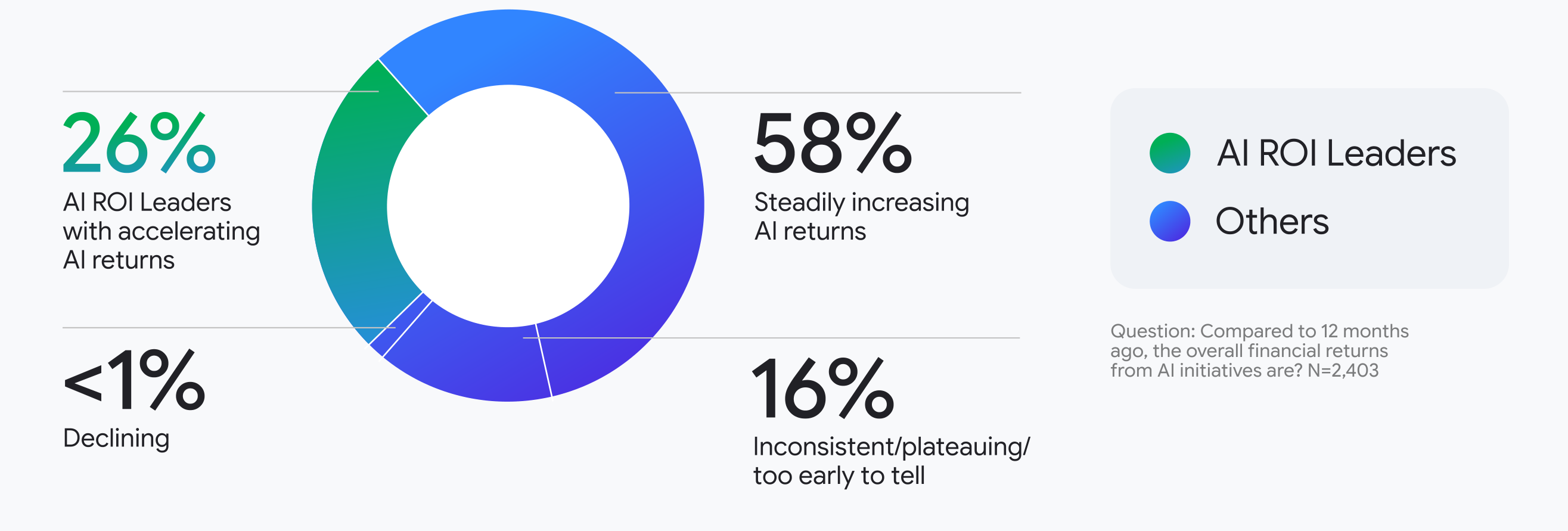
The headline finding of the report is the cohort itself. Asked how the overall financial returns from their AI initiatives compare to twelve months ago, 26% of the 2,403 executives said "accelerating", 58% said steadily increasing, 16% couldn't yet tell, and less than 1% said declining. The leaders aren't just ahead - their lead is compounding, which matters more than any single-year comparison (a point I'll come back to, because it's the real reason to care).
The obvious objection: this is a Google Cloud report, produced by a company with several billion reasons to tell you AI is working. It's a fair objection and I went checking. What I found is that the 26% figure holds up unusually well. In October 2024, Boston Consulting Group ran its own survey of 1,000 C-suite executives, entirely independently, and found that exactly 26% of companies had moved past experimentation to generate tangible value from AI. Gartner's 2026 survey of infrastructure and operations leaders put the share of AI use cases that fully meet ROI expectations at 28%. Three different samples, three methodologies, one answer: roughly a quarter of enterprises are making this pay.
The same checking cuts the other way, though. The report leads with the statistic that 86% of executives agree AI drives cost-efficient growth - and that one deserves a raised eyebrow, because agreement is a feeling, not a financial result. PwC asked its 2026 Global CEO Survey a harder question and got a much colder answer: only 12% of CEOs report verified benefits to both cost and revenue, and 56% report no significant financial benefit at all. Executive sentiment says nearly everyone is winning. Verified accounts say one in eight.
The 95% and the 26% are both true
If you've read anything about enterprise AI this year you'll have met the other famous number: MIT's finding that 95% of generative AI pilots fail to deliver measurable P&L impact. RAND puts enterprise AI failure at around 80%, roughly double the rate of ordinary IT projects. So which is it - a quarter of companies compounding returns, or almost everything failing?
Both. The numbers describe different containers. MIT counted pilots - and most pilots die, at every company, including the successful ones. Google and BCG counted enterprises, some of whose surviving projects went on to compound. PwC counted CEOs willing to sign their name to verified dual benefit, the strictest test of the three. Line them up and they stop contradicting each other and start describing a funnel.
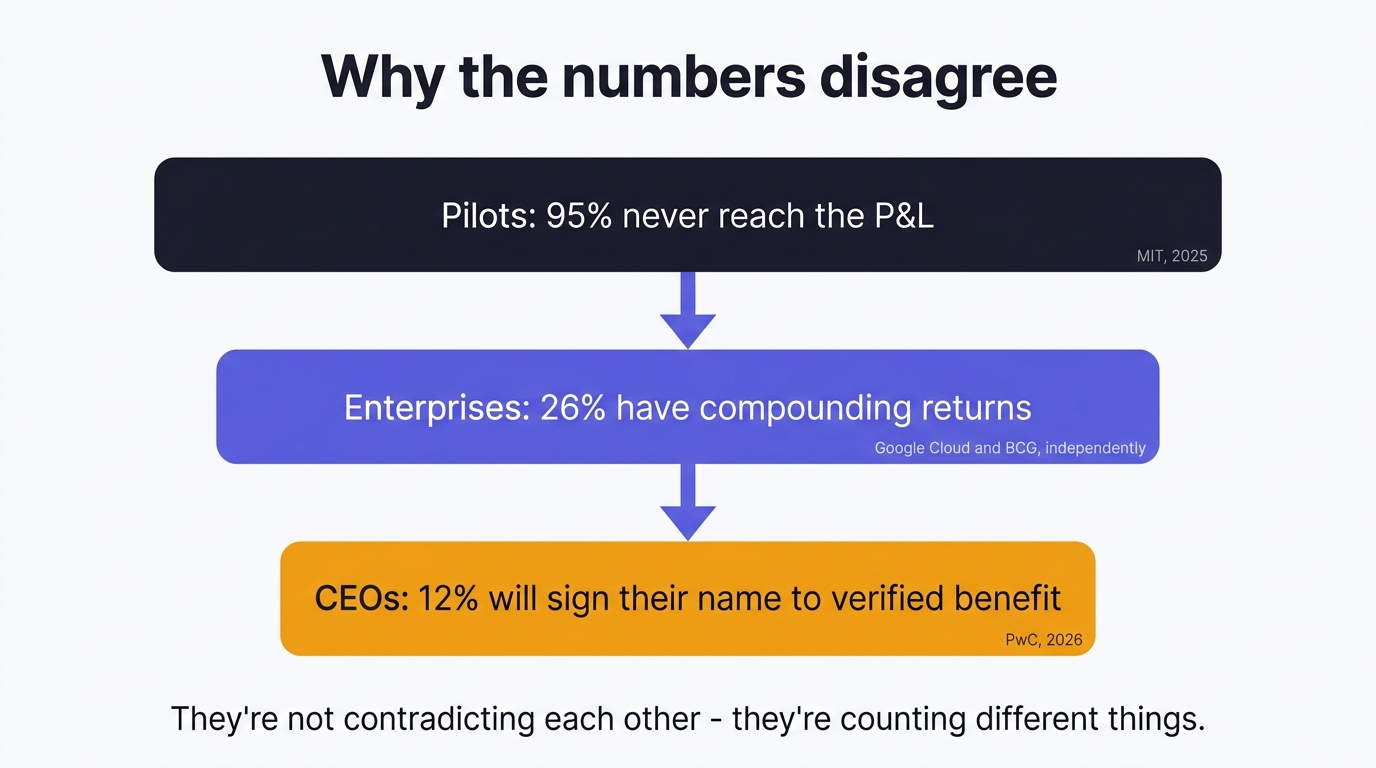
The practical reading: a high pilot death rate is normal and survivable. What separates the 26% is not that their experiments all succeed - it's that the survivors get embedded somewhere they can compound, instead of dying in an inbox. Which brings us to what the leaders are aiming at.
What the leaders aim at
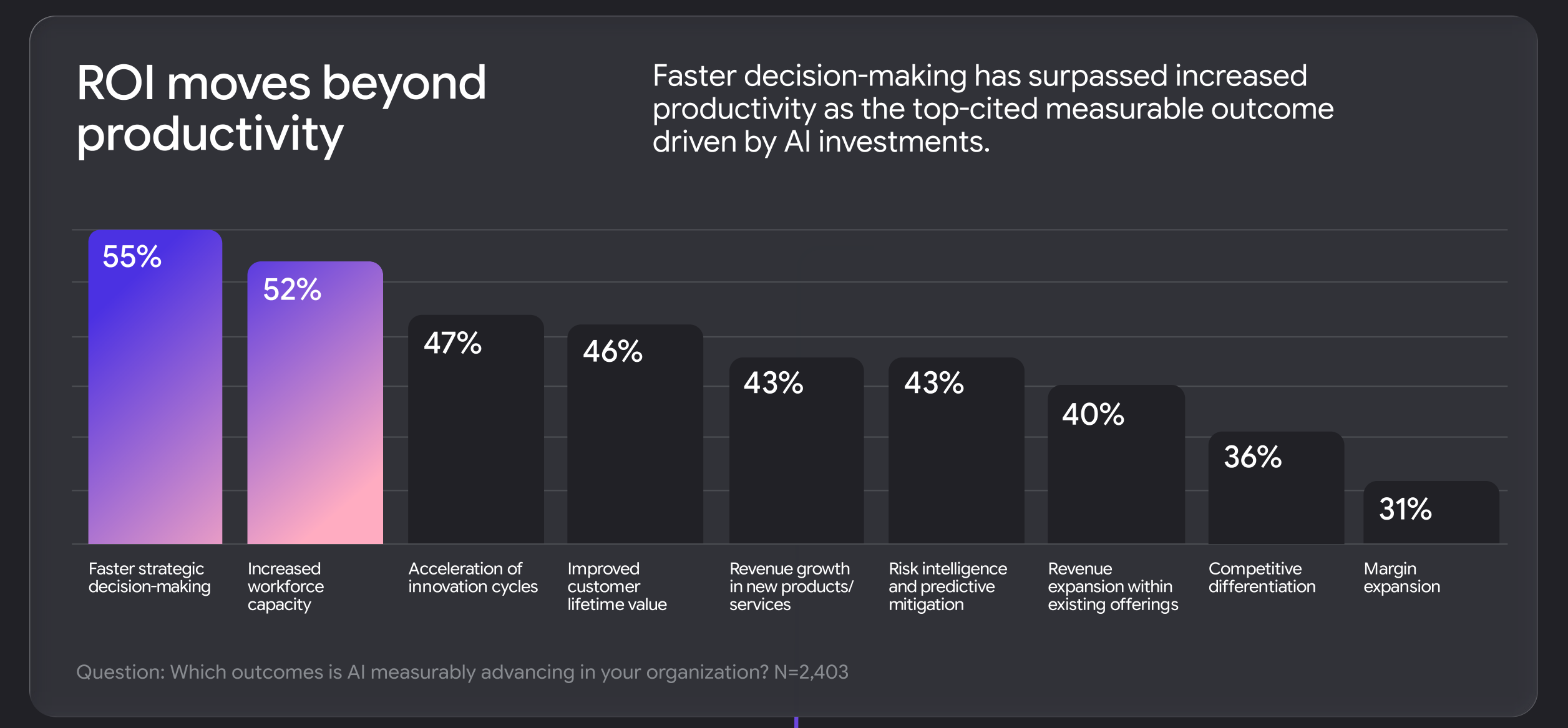
Here's the finding in the report that I think matters most, and it's not the one on the cover. Asked which outcomes AI is measurably advancing, executives put faster strategic decision-making first, at 55% - ahead of increased workforce capacity at 52%. Productivity, the thing almost every AI business case was written around, is no longer the top measured result. Speed of decisions is.
That lines up with the sharpest single statistic in this research cycle, which comes from Gartner, not Google: companies with high AI ROI and companies with negative AI ROI carry out layoffs at essentially identical rates. Headcount reduction - the thing boards keep treating as evidence the AI is working - correlates with nothing. It's a budget decision wearing an AI costume.
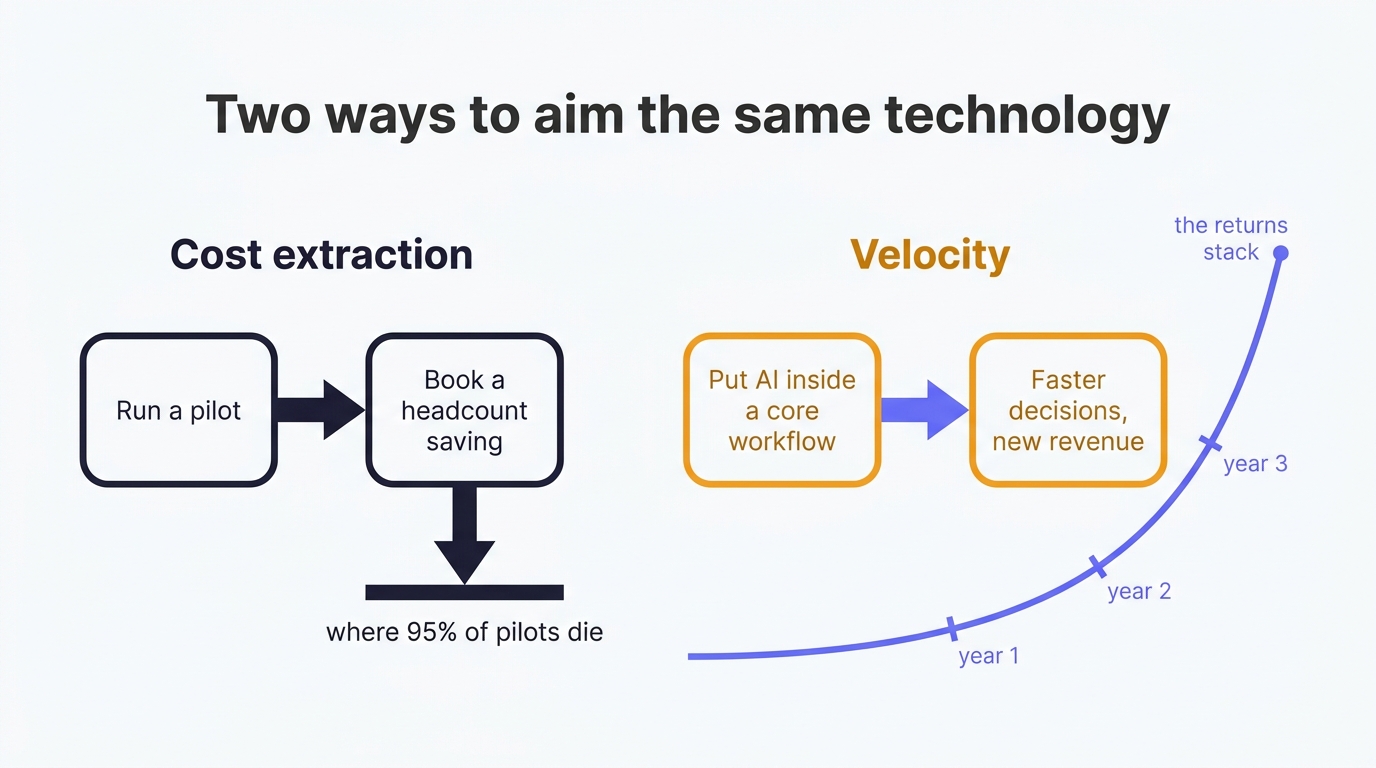
So the picture that emerges is of two different aims for the same technology. The programmes that fail treat AI as a cost-extraction tool: run a pilot, find some headcount, book the saving. Those are the pilots MIT counted. The 26% treat it as a velocity tool: put it inside the workflows where decisions get made and revenue gets generated, and let the returns stack. In the report's data, 94% of respondents say AI agents (software that pursues a goal through multiple steps, rather than answering a single prompt) now contribute to both cost savings and revenue - the winners aren't choosing between the two, they're aiming at the second and collecting the first on the way.
I wrote in AI for the managing director and CEO that integrating AI doesn't mean firing your workforce - it means studying the processes your business has already made stable and adding automation to them, so your people spend less time copying and pasting and more time deciding things. The survey data is that argument with a sample size. The companies making money aimed at the deciding, not the headcount.
So, senior leaders: the next few minutes are the mechanics of how the 26% run things, with the receipts. If you want the strategic case first, the CEO article above is the place to start; operators, the article continues.
The three behaviours
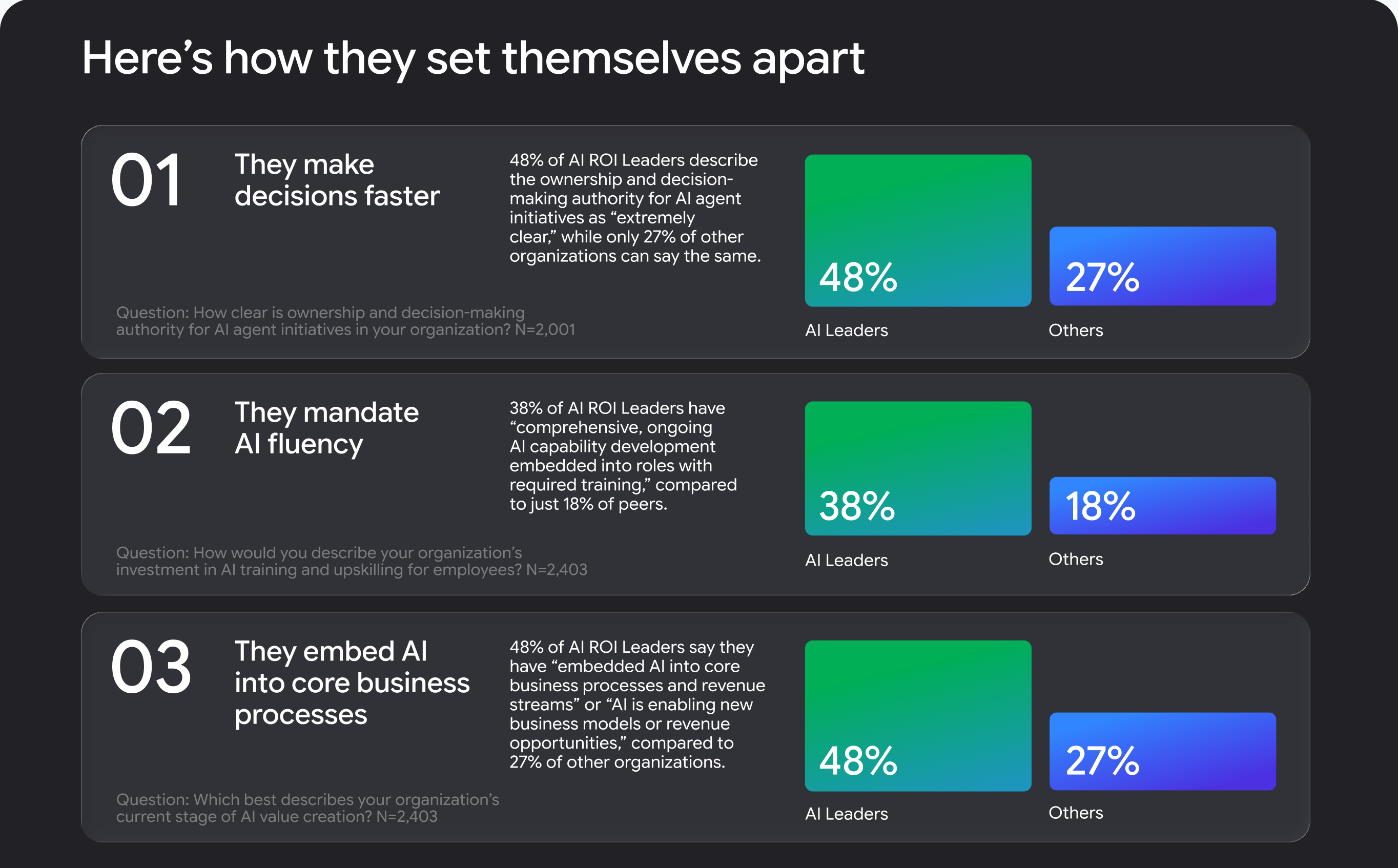
The report identifies three things the leaders do differently, each with a clean gap between them and everyone else. On their own the three sound like consultant wallpaper - clear ownership, training, embedding - so for each one, here's what it looks like in a company you can check up on.
They make decisions faster, because someone is allowed to decide
48% of the leaders describe ownership and decision-making authority for AI agent initiatives as "extremely clear", against 27% of everyone else. Highmark Health is what that looks like in practice: its internal assistant Sidekick delivered $27.9 million of value in 2025 - a figure confirmed by its chief data and analytics officer in the healthcare trade press, not just in a vendor deck - supporting over 13,000 monthly users. That doesn't happen by committee. Somebody owned it, resourced it, and was answerable for the number.
They mandate fluency instead of hoping for it
38% of leaders have ongoing AI capability development embedded into roles with required training, against 18% of the rest. Not lunch-and-learns - required, in the job description. BCG's research on what it calls Trailblazer chief executives points the same way: the leaders' companies have upskilled the majority of their workforce, and the CEOs themselves put in hours on the tools every week. The people don't need to understand how a model works, any more than they understand how Excel works. They need to be fluent in using it, and fluency is a training budget, not a memo.
They embed it where the money already moves
48% of leaders have AI embedded into core business processes and revenue streams, against 27%. This is the one that sounds most like wallpaper and is most concrete in practice. Tata Steel deployed over 300 specialised AI agents across its global operations in nine months - its CIO has described the rollout on the record, built on an internal low-code platform that lets front-line teams create agents for predictive maintenance and supply-chain work. Klarna's customer-service agent handled 2.3 million conversations in its first month, work the company itself equated to roughly 700 full-time agents, with response times falling from eleven minutes to under two. Neither of those is a pilot in a sandbox. They're the core process, running differently. BCG has a blunt formula for why this step defeats most companies: successful AI is roughly 10% algorithms, 20% technology and data, and 70% people and process change. "Embedding AI" doesn't mean buying more licences. It means the unglamorous work of redesigning how the process runs, which is exactly the part most programmes skip.
One honest complication belongs here. In the report's own data, the top-ranked enabler for scaling AI isn't any of the above - it's improved security, compliance and regulatory readiness, at 46%. Gartner and Forrester back that with their research on AI governance; BCG and MIT push back that people and workflow are the real bottleneck. Both camps are right about different stages. Governance is the tollgate: without it, nothing escapes the sandbox, and a pilot that can't touch real data can't produce real returns. But clearing the tollgate generates nothing by itself - the return comes from the workflow redesign on the other side.
Which group is your company in?
The uncomfortable property of the 26% is that almost everyone believes they're in it. The report's own measurement section explains how that illusion survives: only 12% of enterprises use a formal value-tracking framework for AI, and the largest group, 36%, measures success through loose "operational performance improvements". PwC's 12%-verified figure and Google's 12%-with-a-framework are, I suspect, largely the same companies. Most organisations don't know whether their AI is paying because nothing in their reporting could tell them.
So here are the two tests I'd apply, and neither needs a consultant:
- The ownership test. Who owns the P&L for your AI agent initiatives? A named person who can allocate budget and answer for a number puts you in leader territory. A committee, an innovation lab, or "IT, sort of" puts you - on the survey's own numbers - with the 74%.
- The measurement test. If your AI reporting is denominated in hours saved, you're measuring the thing Gartner just showed correlates with nothing. The leaders' outcomes are denominated in decision speed, revenue in new products, and customer lifetime value. Change the denominator and you'll find out very quickly whether there's anything real underneath.
The hiring market is running the same test at scale, incidentally. YubHub, the jobs platform I run, currently indexes 25,000+ AI-related postings, and the titles surging are deployment roles - forward-deployed engineers, applied scientists, people whose job is to take a model and put it against a real organisational problem. Companies vote with headcount budgets long before they publish strategy decks, and they're hiring for embedding, not for strategy. (I'll make one casual prediction: within a couple of years, "owns the AI P&L" will appear in job specs as routinely as "owns the marketing budget" does now. The 48%-versus-27% gap is too profitable to stay unadvertised.)
And the reason to run these tests now rather than at next year's budget round is the word the whole report hangs on: accelerating. A competitor whose returns compound isn't a fixed distance ahead - the gap widens on its own, every quarter, while 97% of surveyed organisations plan to increase AI spend next year and fewer than 0.1% plan to cut it. Nobody is waiting for you to catch up. The cost of a wasted year stopped being the wasted budget and started being the compounding you didn't do.
What to do with this on Monday
The evidence points at a short list, so here it is, in the order I'd do it.
- Name an owner. One person, with budget authority and a number they answer for - the 48/27 ownership gap is the largest single differentiator in the survey, and it costs nothing but a decision. If you want the fuller argument for why this has to come from the top, the CEO article makes it.
- Change the denominator. Retire "hours saved" from your AI reporting and re-cut it by decision speed, revenue contribution and customer value - the outcomes the 26% measure. Your CFO will want the cost side under control at the same time; AI for the CFO covers the four levers for that, and pairs with this piece as the two halves of the ROI fraction.
- Pick one core process and embed. Not a pilot beside the business - a stable, expensive, repetitive process inside it, redesigned with an agent doing the routine work and a person doing the judgement. Fund the training for the people in that process as part of the project, not as an afterthought. Then do the next one.
If you'd like a structured pass through where your business sits against all three behaviours - which processes qualify, what the value-tracking should look like, where the governance tollgate bites - that's what the Houtini AI Audit produces: a ranked brief the senior team can sign off in a quarter.
The 26% aren't cleverer and they didn't spend more. They aimed the same technology at a different target, gave someone the authority to pursue it, and let the returns stack. In my experience the window where that's a differentiator rather than table stakes is short - a couple of years, maybe less. I could be wrong about the timing. I wouldn't bet against the direction.
Survey figures are from Google Cloud's 2026 ROI of AI report (2,403 executives, with National Research Group) unless attributed otherwise; chart images are reproduced from the report, source: google.com. Independent figures are attributed inline to BCG, PwC, Gartner, RAND and MIT. Highmark Health and Tata Steel figures are as confirmed in independent trade press; Klarna's are the company's own reported numbers.
Continue reading.
- How-to GuidesHow to Connect Claude to Shopify with MCP (Dev MCP and Storefront Catalog)
- Beginner's GuidesWhat is n8n? A Beginner's Guide to Workflows, Pricing and Self-Hosting
- How-to GuidesHow to Use AI for Market Research with Claude
- How-to Guidesn8n MCP: How to Connect Claude Code to n8n and Use Its API Safely
- How-to GuidesHow to Run Qwen3-Coder-Next Locally: My vLLM Settings for Two 48GB RTX 4090s
- How-to GuidesHow to Build a Competitor Price Monitoring Pipeline with n8n