The world's first AI-ready job board and data platform
Any company working in the job-board business knows it: getting those first live listings onto your site is painful, and no listings means no traffic, which means no advertiser revenue. That was the problem I was solving for when I launched my motorsport jobs site, fluidjobs.com. YubHub is the platform I built to fix it, and I run it in public at yubhub.co.
What the chore really is
All the current "job backfill" services tend to be highly indiscriminate. They may claim hundreds of thousands of live listings, but if you're working in a niche like Python development or motorsport, those feeds are all but useless. The reason is that jobs live in a mess: every company posts to a different applicant-tracking system - Workday, Greenhouse, Lever, a dozen others - each with its own markup and its own idea of what a salary field looks like. A feed built to grab everything grabs it badly: duplicates, missing salaries, and a category called "Other" that swallows half the listings.
How I built it
With YubHub, you go the other way. You find an employer whose jobs you'd like to feature, and it discovers, fetches, parses and reformats them with AI before serving them as an XML jobs feed.
The spine is a pipeline of Cloudflare Workers, each one a stage that hands off to the next through a queue: discover the job URLs, scrape the pages, enrich them, then syndicate. Every stage has its own dead-letter queue, so a page that fails to parse drops into a tray to be looked at rather than taking the whole run down with it.
Discovery tries the cheap route first - reading a site's sitemap and learning its URL pattern from a single example job - and only reaches for a heavier crawl when the page is JavaScript-rendered. Scraping leans on Firecrawl with a direct-fetch fallback for the sites that block it. Then nineteen platform-specific extractors - Workday, Greenhouse, Lever, Ashby, SmartRecruiters, iCIMS, BambooHR and the rest - each know how to read their own system, tried URL-first and falling back to HTML markers.
The enrichment is where a raw page becomes data. A model running on Cloudflare's own Workers AI - Llama 4 Scout, which won a structured-output bake-off against the alternatives - reads each listing and returns a clean record: title, company, a structured salary with currency and period, required and preferred skills, category, industry, experience level, work arrangement, even a properly-formed postal address. Company logos get cached to R2 so the pages stay fast.
Four ways from one store
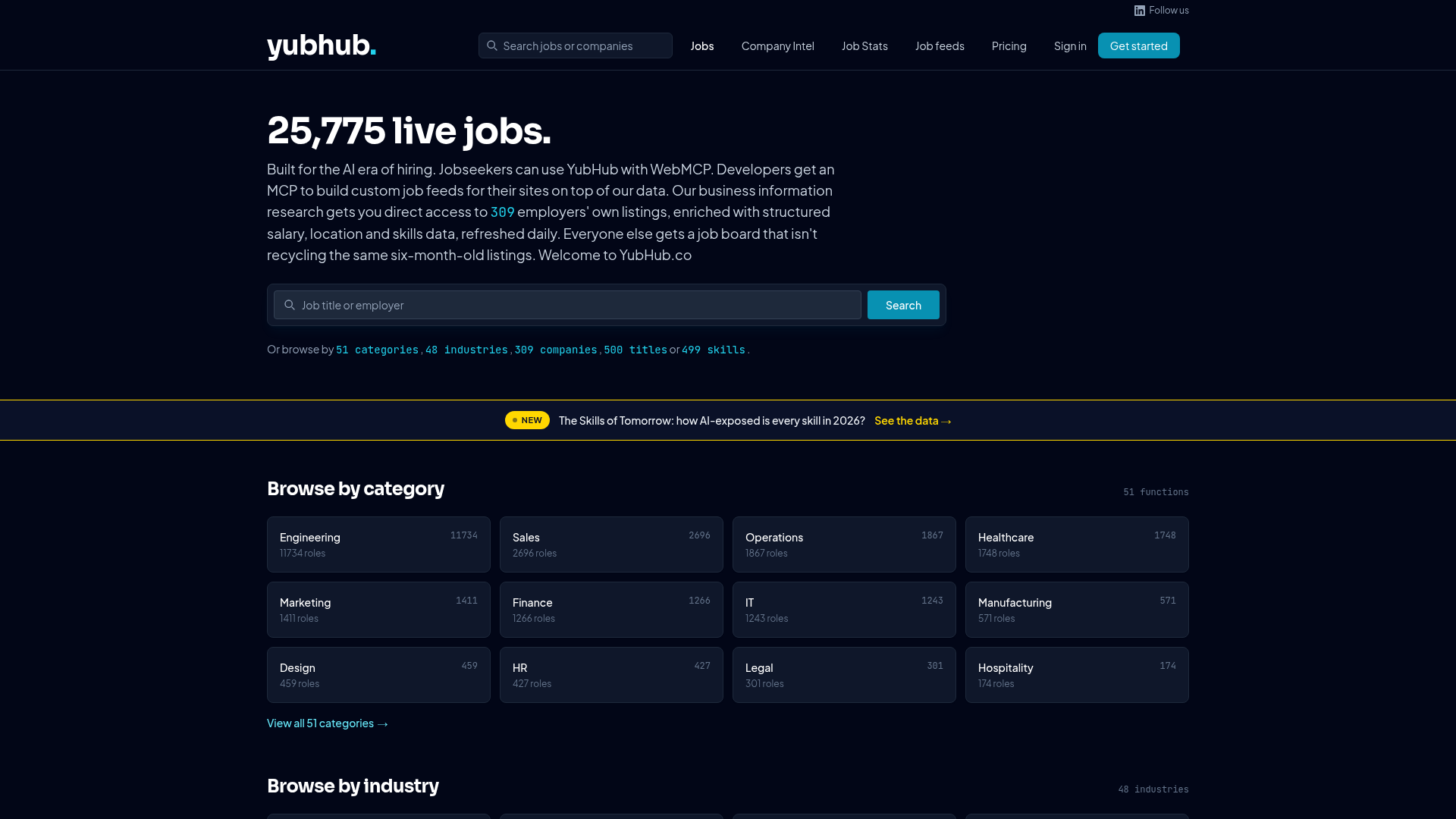
Every enriched job lands in a single Cloudflare D1 database, and from that one store the same corpus goes out four different doors at once. There's the website, for a person. There's a JBoard-format XML feed, for another board to import. There's a jobs.json feed where every entry is a schema.org JobPosting, for a search engine or an AI. And the feeds are free, and sliced by facet: pull one by category, by industry, by skill, by job title or by company - roughly 660 of them, cached at the edge - as XML, JSON or an RSS alert a job-seeker can follow. All free, no login.
Built for agents, not just crawlers
Most sites are, at best, readable by an AI. YubHub is actuatable by one. It ships a WebMCP implementation - one of the first on a live recruitment site - so an agent running in the browser doesn't have to scrape the page, it gets real tools: search jobs, browse by facet, open a listing, build a shortlist. Nine of them, some registering only on the page they're relevant to, all cleaned up the moment you navigate away so an agent never holds a stale handle. Underneath sits the machine-readable surface a serious agent expects: a .well-known/mcp.json describing the tools, an OpenAPI spec, agent-skill files, an llms.txt, and a clean markdown version of every single job. The site is built on the assumption that its next big audience isn't only human.
One footgun from that build: the first version of the shortlist tool let an agent filter by salary and, on jobs where the salary was unknown, happily reported "pays over £X". A confident answer resting on a missing field. It now refuses to make that claim unless the number is there - a strict flag that fails closed. When you hand an agent a tool, its wrong answers are your wrong answers.
Where it stands
Live, running on its own, and a lovely thing to look at. Jobs come in hourly, get enriched on my own edge, and go out as pages, feeds and agent tools without anyone touching the routine path. It's me doing for my own product the thing I do for clients: take a messy real-world data source and turn it into something people, other people's software, and now other people's agents can all use.
Cloudflare Queues pipeline - discovery → Firecrawl scrape → Workers-AI (Llama 4 Scout) enrichment - into D1, syndicated as faceted XML/JSON/RSS feeds and live WebMCP tools + .well-known manifests for agents.