Desktop Commander MCP: Give Claude Full Control of Your Computer (2026)
Desktop Commander is the MCP that gives Claude full read-write access to your computer - files, terminal, code. The setup guide that's missing from the docs, plus the gotchas that catch people on day one.
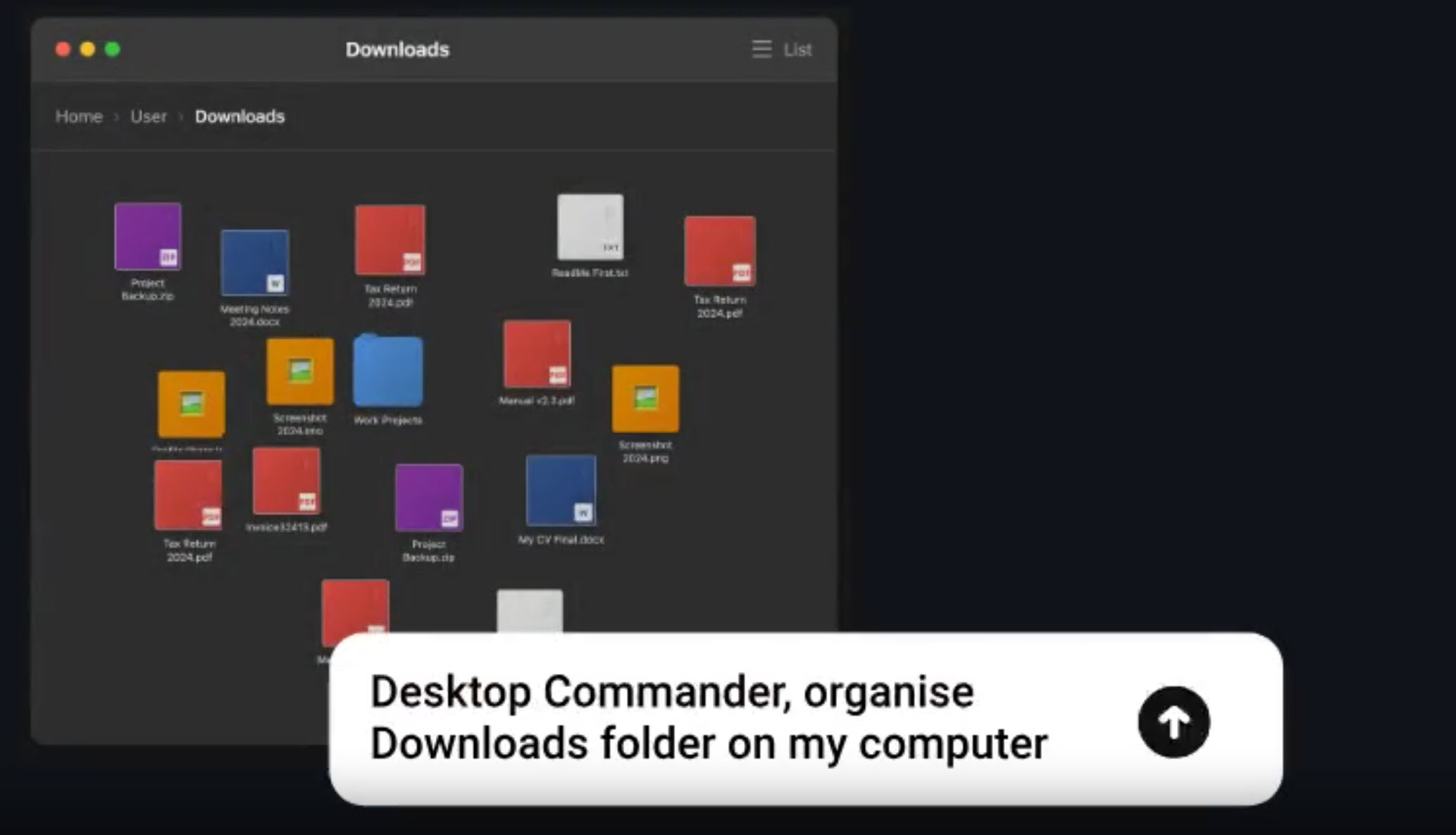
When I discovered Desktop Commander, it quickly became central to how I work with Claude. Put simply, this MCP solves a specific, annoying problem: Claude can tell you what to do, but without access to your filesystem, that's all it can do.
Desktop Commander runs inside Claude Desktop, so a Claude account is the one thing you need first. New to Claude? New accounts get a free week of Claude Code - the same Pro or Max plan covers Claude Desktop.
Desktop Commander is an MCP (Model Context Protocol) extension that gives Claude direct access to your filesystem and (very helpfully) terminal. In practice: Claude can read your files, write new ones, run commands, and interact with your computer the way you would.
The official tagline is "One Chat, Full Stack" and it's spot on.
The Core Problem Desktop Commander Solves
Before Desktop Commander, my Claude conversations went like this:
- Me: "How do I extract this JSON field?"
- Claude: "Here's the jq command:
jq '.data.items[]'" - Me: copies command, switches to terminal, pastes, runs
- Me: "That gave an error"
- Claude: "Ah, try adding
-rflag..." - repeat
With Desktop Commander, that becomes:
- Me: "Extract the items array from response.json"
- Claude: reads file, writes extracted data, tells me it's done
Context-switching and messing around with the disconnect between Claude's internal environment and the real world kills productivity and just creates confusion. Every time I copy-paste between windows, I lose a few seconds and a bit of mental state. Multiply that across hundreds of interactions per day, and it adds up.
Quick Navigation
The Core Problem | How I Use It | What's New | Setup & Download | DC vs Cursor vs Claude Code | Caveats | Security
How I Use It
Content Updates and Creation
One of my projects is called Content Machine - a multi-phase workflow that updates articles with research, voice calibration, and WordPress deployment. Every step is executed through Desktop Commander, triggered via a multi-phase prompt file (sort of like an agent that advises you to switch to a new session, generates a handover prompt ready for you to continue).
While I don't want to give this tool away just yet, here's basically what it does:
Phase 1: Claude downloads the article via WordPress REST API, analyses the existing structure, catalogues shortcodes, html embeds and images.
Phase 2: Claude fetches YouTube transcripts (using Supadata MCP), runs Gemini market research, gathers Amazon product data (with my Amazon Product Advertising API MCP)
Phase 3: Claude extracts technical insights, voice-calibrates content to match my writing patterns.
Phase 4: Claude drafts in Gutenberg HTML, validates, uploads to WordPress as a new draft.
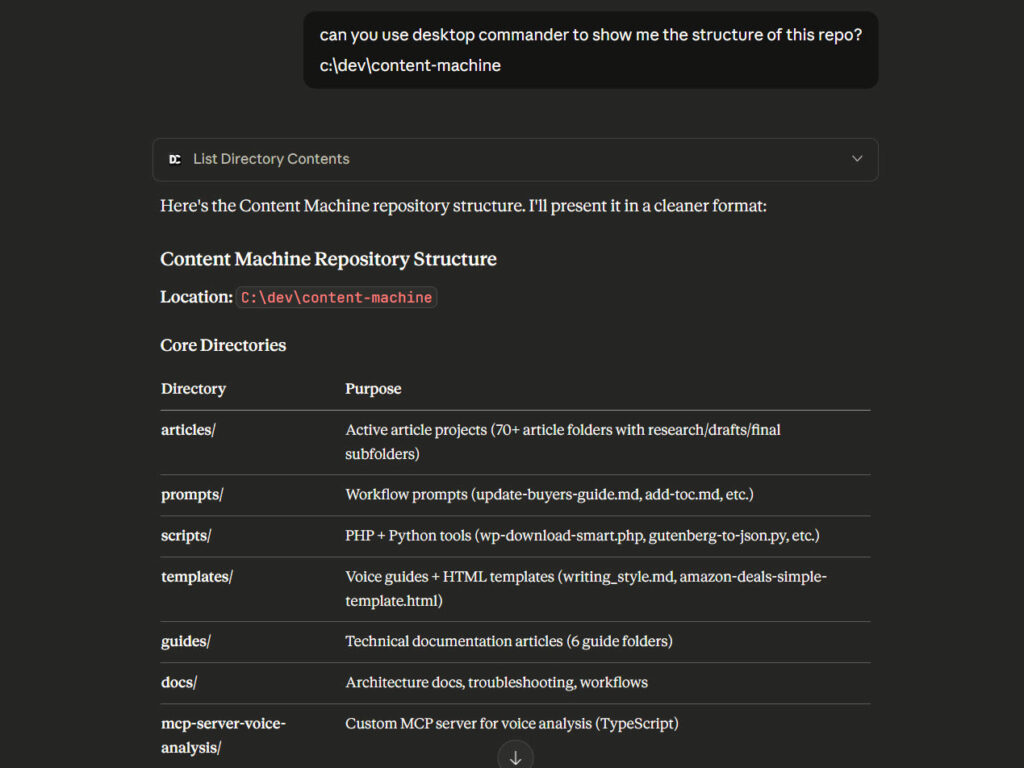
All through natural conversation. No manual file copying. No switching between terminals. The whole thing runs in Claude Desktop with Desktop Commander handling the filesystem operations. For technical writing, documenters and dare I say it, editorial staff - ideas like this change how the work gets done.
Git Operations
I can say "commit these changes with message 'Phase 2 research complete'" and Claude:
- Checks what files changed
- Stages them appropriately
- Writes the commit
- Pushes if I ask
On Windows, this requires batch file workarounds (CMD quote escaping seems problematic), but once configured it works reliably. The cd /d command is essential for changing drives properly. You need github installed - if you're not in that place yet, read this beginner's guide and this setup
@echo off
cd /d C:\dev\content-machine
git add articles\research
git commit -m "Phase 2 complete"
Surgical Code Edits
Most AI coding tools rewrite entire files. Desktop Commander has edit_block - find a specific chunk of code and replace just that section.
Rewriting a 500-line file to change 3 lines is wasteful, error-prone, and often breaks things. Especially in Claude Desktop where you're working in a 200k context window (128k on Sonnet, 200k on Opus). Finding and replacing the exact section preserves everything else.
One of the testimonials I read on the DC site captures this well: "It gives Claude ability to do surgical edits, making it more like a human developer." That's exactly right.
The Self-Improving Pattern
There's a YouTube video going around showing what the creator calls "self-improving AI dev." The core insight: tell Claude to build something, then run the build process, fix errors from the output, and repeat until everything works.
The key prompt addition:
Make the project but change two things. Firstly, you must deliver a perfect project. Launch the project and self-improve both the style and look as well as ensuring everything is implemented properly. Secondly, ensure there are no errors. Fix the errors you find using the terminal logs.
This works because Desktop Commander can read terminal output properly. Claude sees the error, understands the context, makes the fix, runs the build again. The creator reported building a 107-page production-ready Next.js site in one shot.
I've found similar patterns work for PHP and Python scripts. The key is giving Claude access to both the code AND the execution output. npm run build fails with an error? Claude reads it, fixes it, runs again. Loop until clean.
What's New in 2026
Desktop Commander has had a ridiculous amount of development since I first wrote about it. The tool count alone went from a handful to 22 across five categories - and some of the additions changed how I work with it.
Remote MCP is probably the biggest deal. You can now run Desktop Commander from ChatGPT, Claude on the web, or basically any AI service - not just Claude Desktop. Run npx @wonderwhy-er/desktop-commander@latest remote, authenticate with OAuth, and your browser-based AI can control your local machine. I haven't used this much myself but the implications are massive.
Office document support crept in across several releases - Excel files (.xlsx, .xls), PDFs, and Word documents (.docx) all work through the existing read/write/edit tools. So when I said "read this CSV" in my examples above, you can now say "read this spreadsheet" and it just works. Claude can even do surgical XML editing inside .docx files, which sounds niche until you need it.
Docker isolation is the one I'd recommend for anyone nervous about giving an AI write access to their filesystem. Run the whole thing in a container - zero risk to your host system. I still run it natively because I'm reckless (and I trust Git), but the option's there.
Settings Panel and File Preview landed in v0.2.36 and v0.2.38. The settings panel means you don't need to hand-edit JSON config files any more - there's a visual editor right in Claude Desktop. And the file preview widget renders markdown, images, and content inline instead of dumping raw text.
Eduard also launched a standalone Desktop Commander App - separate from the MCP, $7/month, works with GPT-4.5 and Gemini as well as Claude. I haven't tried it and probably won't; the free open-source MCP server does everything I need and I'm not about to add another subscription.
Setup & Download
Requirements:
- Node.js v18 or higher (we're all running v24+ by now)
- Claude Desktop (the app, not claude.ai)
On Windows:
npx @wonderwhy-er/desktop-commander@latest setupOn macOS:
curl -fsSL https://raw.githubusercontent.com/wonderwhy-er/DesktopCommanderMCP/refs/heads/main/install.sh | bashRestart Claude Desktop. That's it.
No API keys. No complex configuration. First thing to try: type "What can I do with Desktop Commander?" and Claude walks you through capabilities.
you can run it as an MCP from the NPM repo with:
    "desktop-commander": {
      "command": "npx",
      "args": [
        "-y",
        "@wonderwhy-er/desktop-commander@latest"
      ]
    }
Or run it in Docker if you want full isolation from your host system:
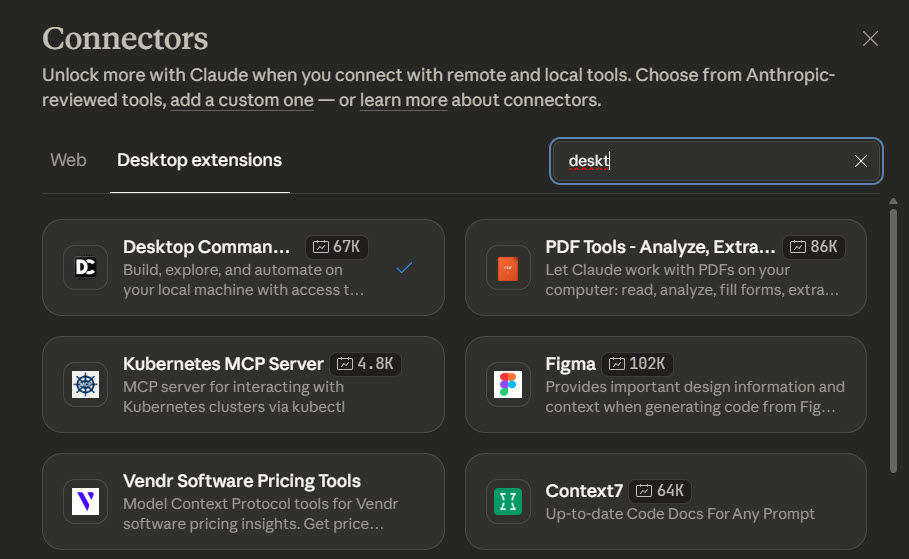
docker run -d --name desktop-commander mcp/desktop-commanderAnd now Desktop Commander is a Claude Extension - by far the easiest way to get started:
DC vs Cursor vs Claude Code
This question's changed since I first wrote this article. Back then it was just Cursor. Now there's Claude Code - Anthropic's own CLI agent that runs in your terminal with full filesystem access, no MCP setup required.
Cursor is a code editor with AI baked in. It's excellent for sitting in a codebase writing features all day.
Claude Code runs in your terminal - no GUI, no MCP config, just npm install -g @anthropic-ai/claude-code and you're in. It's brilliant for developers who live in the terminal already. But it's Claude-only and it's a developer tool through and through.
Claude Desktop + Desktop Commander is the generalist setup. It's what I use because I'm not just coding - I'm researching with Gemini MCP , pulling product data from Amazon, managing WordPress content, and occasionally writing actual code. The MCP ecosystem means I can bolt on whatever capability I need. Claude Code can do MCP too, but Desktop Commander's office document handling and visual file previews don't exist there.
With Cursor, you're thinking "help me code." With Claude Code, you're thinking "do this coding task, autonomously." With Desktop Commander, you're asking "do this task" - and code might be part of it. If it is (it often is) Claude will just write the script and execute it.
The stats: 26k+ weekly NPM downloads, 5.9k GitHub stars, 9.52/10 user rating.
Examples From This Week
WordPress article extraction: "Download article 2264 from (my website) and save the raw JSON to the research folder."
Data filtering: "Read this CSV of products, find all items under £500 with rating above 4.0, export to a new file."
Git housekeeping: "Show me all uncommitted changes, then commit the research files with message 'Phase 2 research complete'."
File audit: "List all .php files in the scripts folder that haven't been modified in 30 days."
None of these are impressive individually. Strung together across a full workflow, the productivity gain compounds.
Where It Breaks Down
Desktop Commander isn't magic. Some honest caveats:
Long-running processes need care. If you start something that takes five minutes, you need to manage timeouts explicitly, and you have to keep a close eye on what's going on. It's OK to stop a Claude thread to check it's on the right track.
Windows has quirks. Git commits in particular require batch file workarounds. Quote escaping in CMD is painful. The cd /d command is essential. I haven't solved this problem yet; other than to establish a template for these things for Claude to follow along with. Minimising mistakes takes a massive amount of pre-preparation and template files seems to be a wise workaround.
Context limits still apply. Claude's context window is large but finite. Complex multi-phase workflows need thread management - I run each phase in a new conversation as I've mentioned before.
It can break things. You're giving an AI write access to your filesystem. This is powerful but requires trust. I keep important work in Git for a reason. By "it" of course I mean Claude, not DC!
Security
I'd be dishonest if I didn't mention this. In February 2026, security firm LayerX disclosed a vulnerability they called "Ace of Aces" - a zero-click remote code execution flaw scored CVSS 10 out of 10. The attack vector: a malicious calendar invite could theoretically trigger terminal commands through Claude Desktop's extension routing, and Desktop Commander's terminal privileges made it the obvious target.
Anthropic's take? "Users grant permission when they install extensions with terminal access." Technically true. Not exactly reassuring. The DC team has since added command blocklist bypass protection, symlink traversal prevention, and audit logging for all tool calls. And there's the Docker isolation option I mentioned - if this stuff worries you, run DC in a container and sleep better at night.
I've been running DC with full filesystem access for months now and it doesn't keep me up at night. I keep everything in Git, I don't run it on machines with production credentials, and I check what Claude's doing before I let it push anything. But know what you're opting into. This is real filesystem access, not a sandbox.
The Prompt Library
Desktop Commander has a prompt library at desktopcommander.app/library with 72+ curated use cases:
- Organise Downloads folder
- Explain Codebase or Repository
- Extract Data from PDFs
- Set Up Local Development Environment
- Generate Docker Configuration
- Manage WordPress site in natural language
- Clean Up Unused Code
Most of these are instant (quick tasks) or step-by-step (complex workflows). Worth browsing to see what's possible.
How Important is This?
Here's my prediction: within two years, everyone working at a desk will have Claude Desktop and Desktop Commander (or equivalent) as core operating software.
Or something similar - there's a productivity surface application opportunity here that I don't think anyone has mastered just yet.
The shift feels inevitable once you've experienced it. Why would I manually navigate folders when I can describe what I want? Why would I copy-paste code when Claude writes it directly? Why would I context-switch between terminal and browser when one interface handles both?
The best prompts aren't in the library anyway. They're the ones you'll discover yourself, five minutes in, when you realise you can just ask Claude to do the task you were about to do manually.
That moment - "wait, I could just ask it to do this" - is when the tool clicks.
Useful links
Related Posts
Continue reading.
- How-to GuidesHow to Stop MCP Servers Eating Your PC: One Docker Gateway for Every Claude Client15 Aug 2026
- How-to GuidesHow to Use the Gemini API (and Why I Run It Next to Claude)15 Aug 2026
- AI ToolsHow to Do a Technical SEO Audit with Claude20 Jul 2026
- ExplainerWhat is a Marketing Engineer (and do you need one)?31 Aug 2026
- AI WorkflowsDynamically updating infographics and content (so you don't have to)28 Aug 2026
- Case StudiesThe parts Shopify Plus B2B doesn't do (and how we built them)28 Aug 2026