

Last week, job data aggregation tool YubHub joined the Houtini family. It pulls listings from careers pages, runs each one through an AI enrichment pipeline, and publishes structured feeds that you can pipe through to your job board software or query programmatically. Title, skills, experience level, location, work arrangement, all normalised across companies – that data is gold.
Quick Navigation
Jump directly to what you’re looking for:
The numbers at a glance |
Anthropic |
OpenAI |
xAI |
DeepMind |
Mistral |
ElevenLabs |
What I think this means |
About the data
As I write this, I’m tracking 82 AI companies. That’s roughly 7,200 job listings over the past few months of which around ~1200 are still live and yet to be filled.
It’s quite the who’s who of the AI industry: OpenAI, Anthropic, xAI, Google DeepMind, Mistral, ElevenLabs, Scale AI, and dozens more. The data I’ve used for this article comes from the official careers pages directly, not aggregated job boards, so, the data is current rather than recycled postings from weeks ago.
The most useful thing you can do with AI is point it at a large, messy dataset and ask what patterns are hiding in there. Pattern recognition at this scale is so powerful – for beginners you just need to add the Claude plugin to Excel. More advanced users can use an MCP or use Claude Code to write a python analysis script to answer your questions directly from the API endpoint.
This article is a worked example of exactly that – YubHub has an MCP and a stats API so you can query your own job data, curated by whatever industry you’d like to analyse.
The numbers at a glance
Engineering dominates in our world. 4,705 of those 7,200+ jobs, roughly 65% of everything have an engineering focus. Sales comes in at 580, then operations (474), finance (395), and marketing (315). No particular surprises, but the job ad ratios between companies tell a very different story, which I’ll get to.
Let’s look at experience first. Senior roles make up 48% of all positions across the dataset. Mid-level is 26%. Entry-level sits at just 18.6%. Look at engineering specifically, and 52% of those roles are in the senior experience level. Operations tilts the other way, with 51% entry-level, but that’s largely data labelling and annotation work at companies like Scale AI.
Companies want veterans who already know the domain cold, and the salary expectations show they’re keen to acquire talent, despite what the news tells us about mass redundancies “because of AI“.
Work arrangements tell their own story. 54.6% onsite. 33.8% hybrid. Fully remote accounts for just 11.2% – personally I think having good people onsite is the only way that true technical and engineering creativity works.
I find that number quite revealing. An industry that sells collaboration and productivity software is, apparently, not very interested in letting its own people use those tools from home. It’s almost certainly a security concern – make of that what you will.
Anthropic: research is the strategy
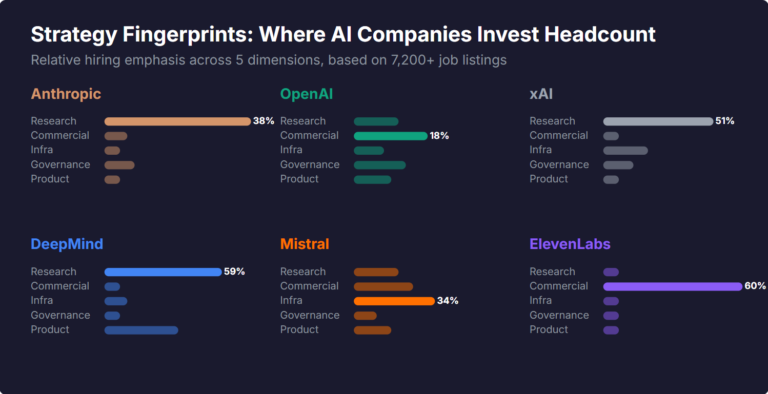
Of all the companies we track, Anthropic has the most focused hiring pattern by far. Out of 445 jobs pulled from their Greenhouse page, the overwhelming majority are Research Engineer positions. I sampled 25 current listings. Eighteen had that title. One more was Research Scientist.
The remaining handful are what you’d expect from a company that still needs to sell its product. Head of Partner Sales. A Finance and Strategy role for EMEA based in Dublin, Marketplace Quality Assurance, a Copyright Operations Program Manager, which tells you something about where IP disputes are heading in this industry.
There’s a Health and Life Science public policy role too, hinting at vertical ambitions down the line. But you can read Anthropic’s entire hiring thesis in one sentence: the moat is model capability in specialisms, and nearly all headcount goes behind that bet.
The Dublin posting deserves a second look. It shows geographic expansion creeping in even at a company this research-heavy. European go-to-market infrastructure is becoming a requirement for these labs whether they originally planned for it or not.
OpenAI: the enterprise play
I expected OpenAI’s hiring to look similar to Anthropic’s as the layman might assume they do the same thing. But, with 614 listings, OpenAI’s hiring strategy reads far more like a mid-stage enterprise SaaS company than a research lab.
Interestingly, they’re hiring Forward Deployed Engineers. That’s a title Palantir popularised, and it means something specific: you embed engineers directly with large customers, help them build integrations and solve their domain problems on site. It’s expensive, high-touch, and very much an enterprise sales motion rather than a product-led one.
The role diversity at OpenAI is also very interesting; Revenue Accounting. Tax Technology Lead. Revenue Risk and Compliance across at least three separate roles. Growth marketing for emails, notifications and lifecycle and Account Directors for client expansion. A Partner Solutions Engineer based in Tokyo, an AI Deployment Manager for Education, operating out of Dublin.
Then there’s the geopolitical layer. A Head of National Security Policy for APAC working out of Singapore. A Global Safety Response Operations Analyst. A Researcher in Frontier Cybersecurity Risks. I wasn’t expecting that to be so visible in the jobs data, but it’s there, spread across multiple roles and geographies. OpenAI has built itself into a government-facing, globally-regulated technology company, and the hiring reflects that in a way their marketing doesn’t.
Revenue operations are getting at least as much attention as research now. Possibly more.
xAI: training Grok through domain experts
This is a highly revealing hiring pattern.
xAI has 192 tracked jobs, and the shape of their hiring is unlike anything at the other labs. They’re bringing in AI Tutors across very specific domains: chemistry, statistics, software engineering, legal compliance. There’s a role called “Model Behavior Tutor, Wit & Conversation” which, if I’m understanding this correctly, is someone hired specifically to make Grok funnier.
Then there’s a cluster of finance domain specialists that tells an interesting and again, it’s a very different story to the other companies. Investment Banking M&A, Quant, Real Estate Investment, Risk, Tax, and Technical Accounting are on the hiring list.
They’re teaching Grok how financial markets work through RLHF and fine-tuning, at a level of depth that a general-purpose research engineer might not be able to simply come up with. The “hire domain specialists” approach is a completely different theory approaching model quality compared to Anthropic’s “hire more researchers” approach. This may explain Elon’s “not built right the first time” thought process.
Infrastructure is visible too. An AI/HPC Network Development Engineer for the Colossus data centre, plus a Facilities Operations Technician in Memphis, Tennessee, which is where Colossus is physically located. You can literally see the compute buildout playing out in real time through their jobs page.
There’s an interesting government angle, too. Mission Manager for International Government with postings in Dubai and London. Member of Technical Staff for Government based in Washington DC. And a Member of Technical Staff for X Platform Security, which makes the xAI-to-Twitter integration explicit in a way that the PR messaging tends to avoid.
DeepMind: robotics and whatever comes next
Google DeepMind’s 107 tracked listings split fairly neatly into two investment bets.
Robotics is the first. Research Scientist for Safety and Alignment for Humanoid Robotics. Research Engineer for Embodied Generalist Agent, based in Tokyo. A Research Engineer for Developer Experience in Gemini Robotics. That last role is quite telling, because they’re already building developer tooling around their robotics stack. They expect external developers to build on this before long – the Android of robotics, most likely.
The second bet is Gemini App productisation. Product Manager for Growth and Discovery Platform. Senior Staff UX Researcher. AI Product Designer for GeminiApp iOS Experience. And a Product Manager for Gemini App, Very Small Businesses, which tells you they’re thinking well beyond enterprise customers and into the long tail.
Then there’s one listing I keep coming back to. “Research Scientist, Post-AGI Research.” Just posted publicly on their Greenhouse page like it’s a normal thing. I’m not sure what to make of that, but there it is. Just let that sit there for a moment.
Mistral: the European deployment play
Mistral has 128 tracked jobs, and their hiring pattern looks quite different from the US labs.
The biggest signal is “AI Deployment Strategist” with 11 open roles. Eleven. That’s their primary go-to-market motion, and it’s more consultative than the Forward Deployed Engineer approach at OpenAI. Where OpenAI embeds engineers with customers, Mistral is sending strategists. The distinction matters, because it suggests they’re selling transformation rather than integration.
They’ve got a partnership with SAP, backed by a Strategic Partner Lead for SAP and a dedicated SAP Platform Manager. If you’re a European AI company trying to break into enterprise accounts, embedding into the software stack those businesses already run makes a lot of sense.
One role caught my attention more than the others. Senior Compute Legal Counsel. As GPU compute becomes the bottleneck across the whole industry, the legal complexity around procurement, capacity agreements and cross-border data processing has become its own discipline. That role would not have existed two years ago.
Paris remains home base, but I’m seeing roles in London, Palo Alto, Singapore, Munich, and New York. European-headquartered but globally distributed. The positioning against the US-centric labs looks deliberate to me.
ElevenLabs: all in on sales
ElevenLabs has 100 jobs tracked. The overwhelming majority are commercial roles.
Account Executives across North America, split by enterprise and mid-market. Revenue Leads for Korea, Spain, and France. SDRs. Customer Success split four ways by account size: Corporate, Mid-Market, Enterprise, Strategic. That’s a mature sales organisation structure for a company this size.
Engineering roles are almost invisible. My read is that the product has matured enough that the bottleneck has shifted from building to distribution. They’re also bringing in Translators and Linguists on freelance contracts, which makes sense for a voice synthesis company expanding into more languages simultaneously.
ElevenLabs has picked up the Forward Deployed Engineer title too, with a posting in Spain. I’ve now seen this title at OpenAI, ElevenLabs, and referenced at several other AI companies. Palantir built the playbook for embedded enterprise engineering and the industry seems to have adopted it wholesale. Two years ago that title barely existed outside Palantir itself.
What I think this means
Where a company spends its headcount tells you what they believe their competitive advantage is. Full stop.
Anthropic thinks it’s model research. OpenAI is betting on enterprise distribution and vertical sales. xAI is investing in domain-expert training to build model quality from the ground up. DeepMind is hedging into robotics and post-AGI research. Mistral is carving out European enterprise deployment. ElevenLabs has decided the product is done and it’s time to sell.
Six different bets on where the moat sits. They can’t all be right.
The commercialisation pressure is visible everywhere. Sales is the second-biggest job category across the dataset, and companies like ElevenLabs are putting nearly their entire headcount into revenue operations. The era where AI labs could run as pure research outfits funded by venture capital feels like it’s winding down. Two new job titles have emerged as industry standards that didn’t exist before: Forward Deployed Engineer and AI Deployment Strategist. Both signal that getting the technology into customer hands, not just building it, has become the bottleneck.
I mentioned the remote work numbers earlier, but they bear repeating here. 11.2% fully remote in an industry that sells collaboration tools. And with 48% of roles at senior level versus just 18.6% entry-level, these companies want experience. Deep expertise. If you’re looking to break into AI, the data suggests you need to bring genuine domain knowledge, whether that’s ML research, enterprise sales, or understanding investment banking well enough to teach it to a language model.
About the data
I should mention that I built YubHub, so there’s an obvious bias in featuring it here. That said, I couldn’t have constructed this analysis any other way. Clicking through careers pages one at a time across dozens of companies doesn’t surface cross-company patterns. You need structured data for that: thousands of listings with consistent fields you can filter and compare.
Pattern recognition at scale is the my favourite use case for LLMs. Taking messy real-world data and turning it into something you can reason about at a scale that would be completely impractical to do by hand (unless you had a team of 100’s or months to do the bean counting)
Data was pulled on 15 March 2026 across 82 active feeds. Company totals reflect the full enriched dataset: Anthropic 445, OpenAI 614, xAI 192, DeepMind 107, Mistral 128, ElevenLabs 100. If you want to poke around the raw numbers yourself, the stats dashboard at yubhub.co is public.
Related Articles
What Skills Are AI Companies Hiring For, and What Do the Jobs Tell Us About Their Strategy?
I pointed YubHub at 7,200+ job listings across the major AI labs and the hiring patterns reveal six completely different strategic bets. Anthropic is all-in on research. OpenAI reads like an enterprise SaaS company. xAI is hiring domain experts to teach Grok finance. Here's what the data shows.
How to Create LinkedIn Carousel Slides with Gemini and Claude
A developer workflow for turning blog posts into LinkedIn carousel slides using Gemini SVG generation, Puppeteer PDF conversion, and a four-line Python merge script. No Canva, no SaaS tools.
What Is an MCP Server? And, Why It Matters for AI Tool Use
My daily work literally depends on the existence of MCP servers now, spread between Claude Desktop and Claude Code. Database queries, image generation, web scraping, file management, search console data, email. Much of my daily working world lives in a conversation window. I am convinced we are at the beginning of a radical shift in … <a title="Best AI PCs for Running Local LLMs" class="read-more" href="https://houtini.com/best-pcs-for-local-ai-tested-specs-for-running-llms-without-the-cloud/" aria-label="Read more about Best AI PCs for Running Local LLMs">Read more</a>
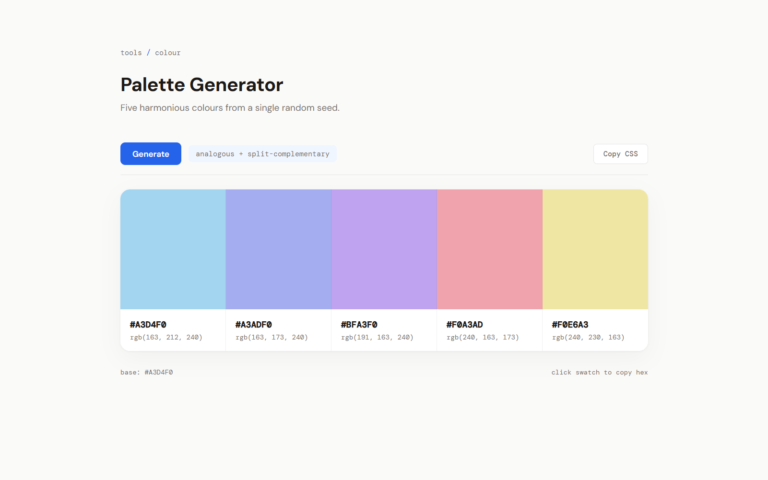
How to Improve Your AI Prototype Designs with Skills, Prompts and Gemini
I build a lot of single-file HTML prototypes with Claude Code. They work, but they all end up looking the same. I tested three approaches to fix this – Claude Skills, manual prompt engineering, and Gemini MCP feedback.
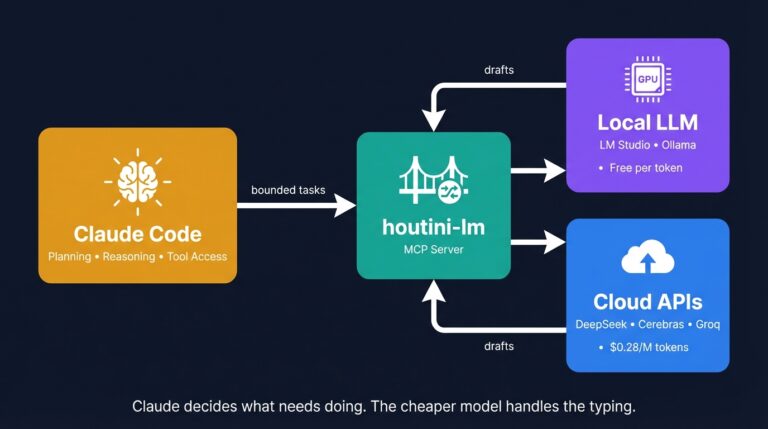
How to Cut Your Claude Code Bill by Offloading Work to Cheaper Models (with houtini-lm)
I built houtini-lm because I think there will be a time when your Anthropic bill will be getting a touch out of hand. In my experience, deals that seem a bit too good to be true do not last. Just this week I left Claude Code running a massive overnight refactor. I woke up, and, … <a title="Best AI PCs for Running Local LLMs" class="read-more" href="https://houtini.com/best-pcs-for-local-ai-tested-specs-for-running-llms-without-the-cloud/" aria-label="Read more about Best AI PCs for Running Local LLMs">Read more</a>
Claude Code: The Complete Beginner’s Guide
I’ve been running Claude Code every day for the last few months. MCP servers, articles across three sites, Python scripts, content workflows that run from research straight through to WordPress upload. Nothing’s changed how I work this much since I first picked up MS Excel 20 years ago. What in today’s posts is most of … <a title="Best AI PCs for Running Local LLMs" class="read-more" href="https://houtini.com/best-pcs-for-local-ai-tested-specs-for-running-llms-without-the-cloud/" aria-label="Read more about Best AI PCs for Running Local LLMs">Read more</a>