
Not that long ago, I was searching for an answer to a question about a USB device and whether it needed a separate PSU. This happened to be a topic very close to my heart, and owning a handful of affiliate content sites on the topic, this should have been something I already knew.
It should have been a piece of information included in a review I’d written just a year before. But I hadn’t thought to mention this particular answer, and, as an unfortunate result, my review page didn’t appear in Google’s AI search results.
The lesson: Be useful, complete in your writing and have empathy for your users’ needs, or disappear.
Sitting down to unpick and edit hundreds, if not thousands of pages to develop them to be more helpful, and consequently, perform better in AI search results, is a bit of a daunting task. It’s a job that will fall to your content team, which means they’ll need a brief or something else.
Building in public
I built this tool to solve my problem: how can I speed up the content review process so I have information to steer my editorial in the right direction?
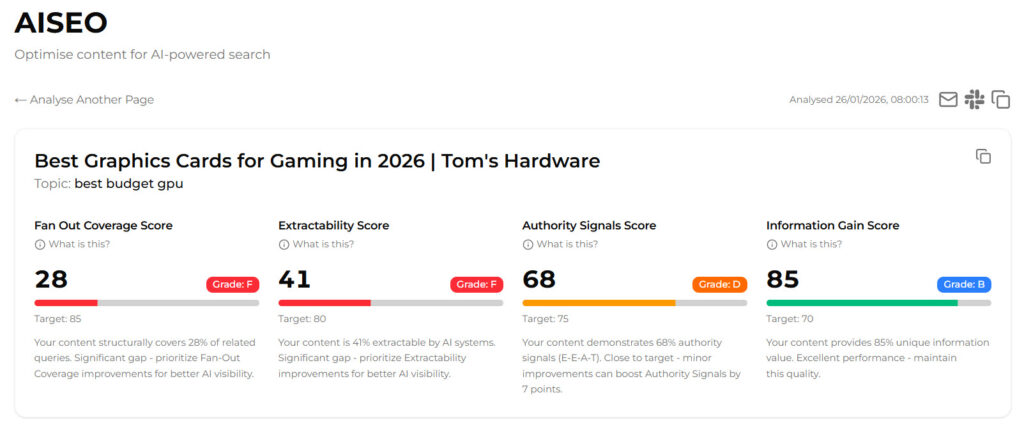
Analysis Summary: aiseo.houtini.com
How does it work?
The analysis is part deterministic, part AI-powered. It uses Gemini 3.0 flash, which, aside from being the current model to power Google’s AI Mode, has recommendations that are significantly more actionable than its predecessors:
“Add a highlighted summary box at the start of the ‘The 5 Best Gloves for Sim-Racing’ section. Specific rewrite: ‘Our Verdict: The Sparco Hypergrip remains the gold standard for 2026, offering better breathability than competitors and unique touch-screen sensitive fingertips for mid-race adjustments”
I don’t recommend you re-use the verbatim copy generated (as it’s AI and that’s not smart) *but* you can use it as inspiration for what you feel are teh most important takeaways to add to inform your readers. Especially if that information is uniquely created from your own personal insight.
How to use AI SEO
I’m hopeful my prototype is intuitive enough that you can start to see what areas in your content might need a little refinement or further research:
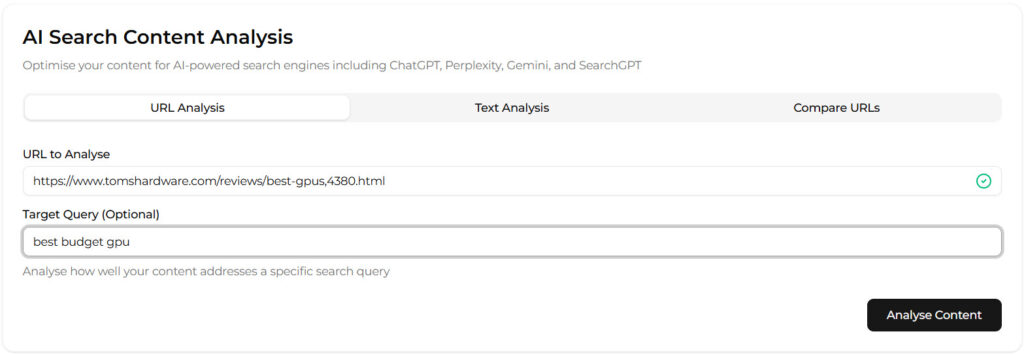
Analysis Report Sections
Overall Performance Scorecard
You’ll see four scores, 0-100, with grading:
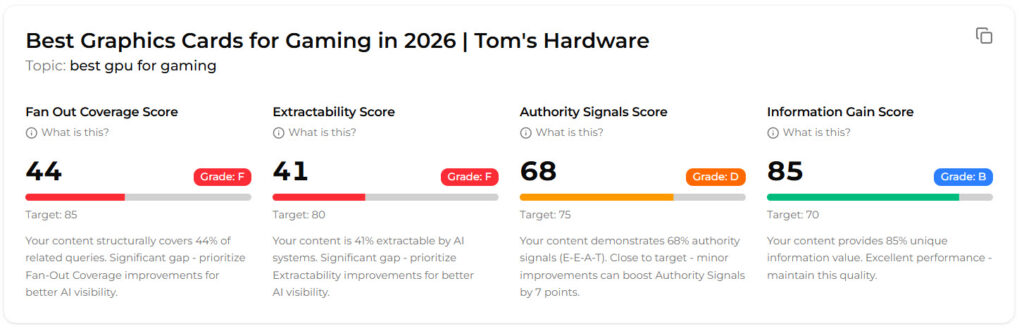
Fan Out Coverage – How well does your copy answer questions likely to be related to the article?
In writing, you’ll naturally address related ideas around a topic. If we’re using our gaming GPU example from above, I would naturally expect you to explore related ideas too. “What is a good budget GPU for 1080p gaming?” for example.
Further reading: What is Query Fan Out? – Hobo Web | Complete Guide to Topic Clusters – SearchEngineLand
Extractability – How easy is it for AI to pull relevant chunks of information from your content?
According to research from Dejan AI, around 1/3 of your content, on average, will “make it” into the model. Think of Google’s AI as a reader with a “Grounding Budget” who only has space for around 2,000 words distributed across multiple sources for each query.
Higher-ranking content typically receives a larger share of this budget, so the AI has to be picky about what information it extracts.
Further reading: How much of your content survives the AI Search filter? – Dejan | How big are Google’s grounding chunks? – Dejan
Authority Signals – How trustworthy does your page seem?
Think of Authority a little like the AI model checking your credentials.
When you’re writing, you ought to be writing with real-world experience, on a site that is considered a topical authority on your subject. The general rules for a copywriter: speak in specific terms about your firsthand experience and weave in unique observations that may not have been covered in previous editorial. Using my GPU example – did you hear any coil whine, was it loud? What performance settings improved it or made it worse?
Use source attribution and check your facts. Rather than using vague language (we’ll come on to that in a moment) cite facts and state the source. Performance benchmarks, technical specifications, and the manufacturer’s datasheet. Make your content easy to verify and use specificity in your sentence construction.
Follow the Consensus principle. AI models use Grounding. If there’s consensus on the data you present (meaning your information is matched and confirmed by other high-authority sources), it may help promote your work as a reliable source. Avoid vague / “filler” content.
Further Reading: E-E-A-T: Experience, Expertise, Authoritativeness, and Trustworthiness – Lily Ray | Creating helpful, reliable, people-first content – Google
Information Gain – Does your content add something new to the corpus of all human knowledge?
You might remember the days when “great” content was probably very long, verbose and that you could outrank another page simply by improving a little bit on what had been said already. If you had a high authority (well-linked to) domain, this was particularly easy. Our AI doesn’t need to read another article on the same ideas. As a writer, ask yourself questions like “Am I adding new insight, or a new data point to this paragraph?”
Offer fresh or substantive insight over other articles that may seem formulaic and uninsightful, and there’s a good chance you’ll find competing for visibility easier.
To improve your information gain, seek out new data. A very good approach (I’ve found) is to synthesise existing information from multiple previous sources and update it with current context, add a differing point of view on previous cited works, or experiment with better formatting (table data, more visual/creative presentation, build an app or interactive asset). Whilst generating entirely new research is ideal, thoughtfully combining and updating existing information is often more achievable and still delivers genuine value.
Further reading: Google’s Information Gain Patent (link) | Beyond Reddit and Quora: How Google’s Hidden Gems Update Yielded Explosive Growth In Search Visibility For Many Forums – GSQi
All Findings (Actionable Improvements)
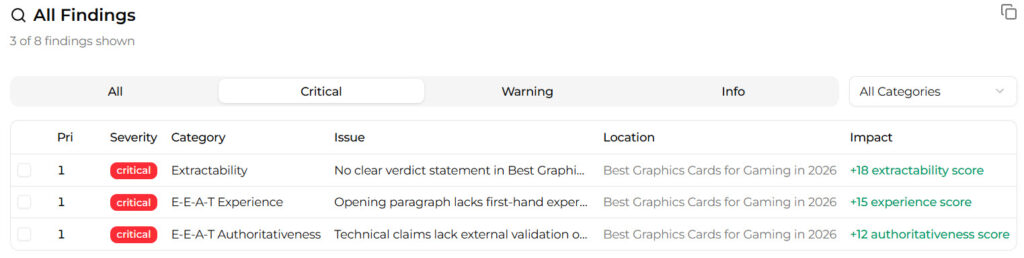
All findings – your to-do list
Here’s an example of a vague modifier:
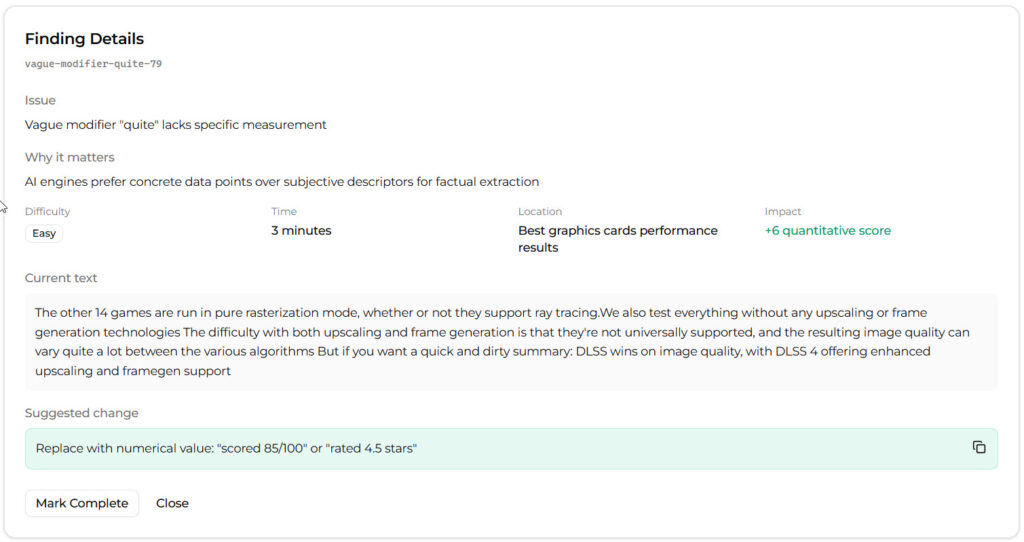
This section of the tool shows you the paragraph that could be improved with a suggestion. Again, use the suggestion as a direction on where you might be able to improve your statement, rather than copying the example.
Vague modifiers plague my own writing, which is chiefly the main reason I wanted a tool to help me find and weed out the worst of it. I’m particularly aghast at my excessive use of “really”, “pretty much”, and “almost every”. We’re not all born with a background in writing, so take a look at these resources for guidance:
Further reading: Effective Storytelling: Bottom Line Up Front Explained – Jeff Gothelf | Writing: Weeding Out Modifiers – Linda S Clare
Coverage Gaps (Missing Content Opportunities)
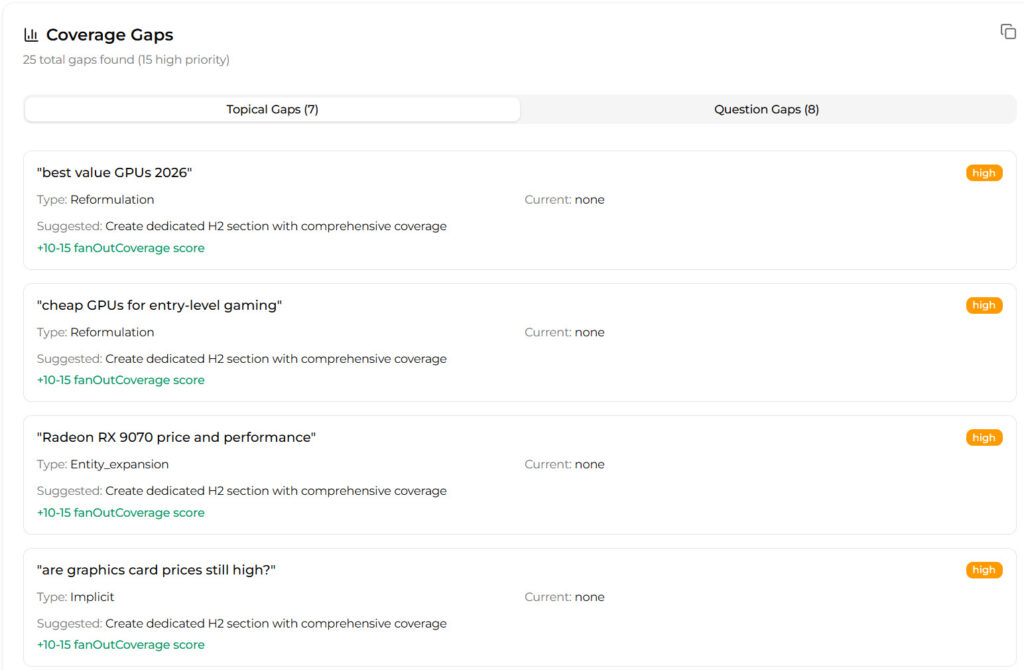
In the Coverage Gaps section, you’ll see two tabs: Topical Gaps and Question Gaps.
Topical gaps are queries that are related to the phrase you submitted that might not be covered well on the page. As an example, a comparison between two products. Using my GPU example: “NVIDIA 5080 vs 4090”, included as a section if you’ve also recently tested the predecessor of a product.
While I don’t always like the suggestions (nobody’s perfect), there’s some inspiration in this report on which direction to take your copy. “Are graphics card prices still high?” is a non-starter for me, but changing it to “Why are graphics card prices so high?” offers the author the opportunity to provide some insight into the reason why there are shortages, and to offer advice on what is available or provide equivalent alternatives to their reader.
Question Gaps are actionable snippets of questions suggested by Gemini that are related to the topic. Is 16gb of VRAM sufficient for iRacing?
The answer (as it happens) is yes; because the ancient graphics engine that powers that software can’t use VRAM above 16gb. That’s insight that I have gained firsthand through being an enthusiastic sim racer.
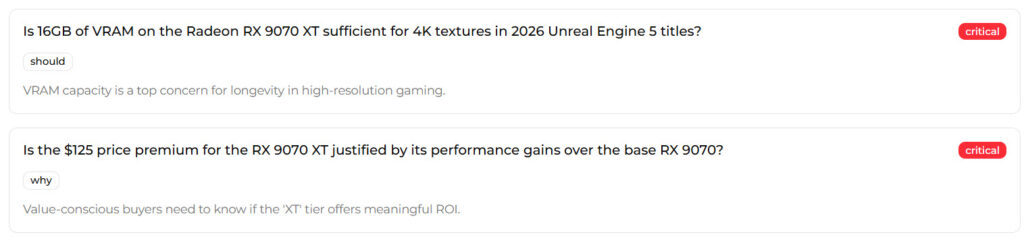
Start by reviewing the higher priority gaps and questions, and carry out some research to support what could be included in your work. You should, intuitively, have a feel for what will work and what won’t. That intuition is a product of your expertise and experience on the subject.
Quick Wins (Fast, High-Impact Changes)
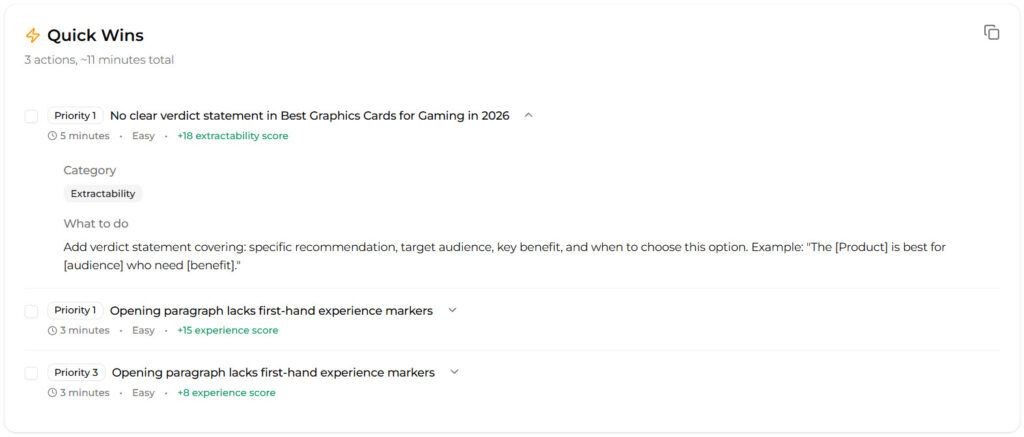
I’ve built quick wins to summarise the API output and give you a working surface to track the changes you’ve completed in that session. Sorry, but this isn’t save,d so a page refresh or the back button will lose the data. If you think you’d like to save your history, I can do that. Let me know!
In the report, you’ll get 3-5 specific items you can complete in under 10 minutes each that deliver the biggest score improvements. Small changes with a good chance of a high impact. Thinking about BLUF for a moment: “Add verdict statement to opening paragraph” – it won’t hurt your page performance to briefly summarise the verdict in the opening section(s) of your page.
Think of your opening section much like an Executive summary. Without giving the full article away, you can certainly write a teaser with a taste of the information before you start working through the full body of the text. Think about the Inverted Pyramid rule (Associated Press). Place the fundamental facts at the top of the story.
Further reading: How to optimise content for AI search engines: A step-by-step guide – SearchEngineLand | The Inverted Pyramid rule – nngroup.com
Your Key Takeaways
I built AISEO to help me with my own content challenges. I hope you’ll find it a useful guide too.
AISEO’s goal is to help you see:
- What’s missing (Coverage and Topical Gaps)
- What’s unclear (Extractability)
- What’s unverified (Authority)
- What’s generic (Information Gain opportunity)
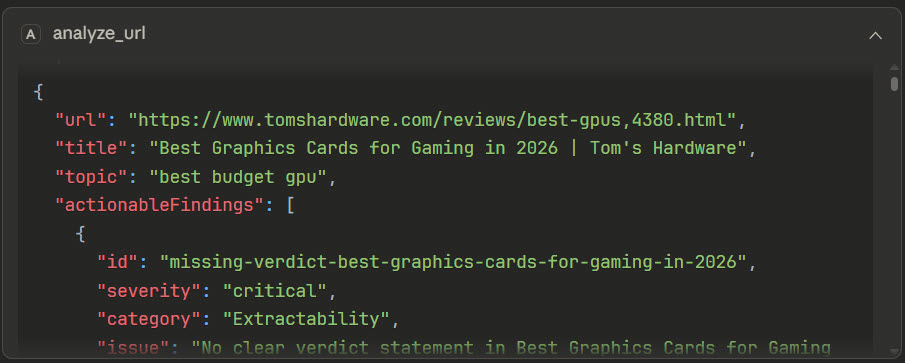
I’d love to hear your feedback! On the technical side, AISEO runs from an API service hosted on Google Cloud Run, which I’ve built inspired by the open source MCPs I created on Houtini-AI. AISEO runs from an API service hosted on Google Cloud Run, built as an MCP server (like my other open-source MCPs on Houtini-AI). It’s an entirely separate codebase with JWT authentication provided via Supabase and a UI component built in Next.js on Vercel.
If you’re interested, I run requests from Claude Desktop directly to the API via my MCP server, which I’m considering making available if the project has enough interest. Let me know!
If you have any questions, or if you have feedback or an enquiry, I’d love to help. Get in touch!
Related Posts
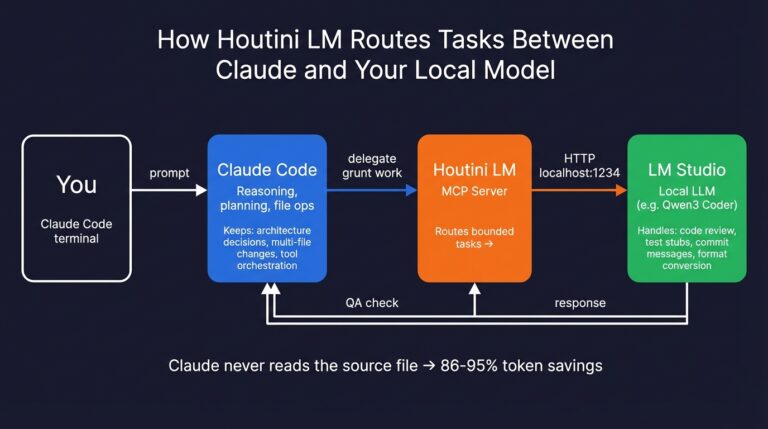
How to Set Up LM Studio: Running AI Models on Your Own Hardware
How does anyone end up running their own AI models locally? For me, it started because of a deep interest in GPUs and powerful computers. I’ve got a machine on my network called “hopper” with six NVIDIA GPUs and 256GB of RAM, and I’d been using it for various tasks already, so the idea of … <a title="AI SEO – A Tool to Help You Improve Your Content for AI Search" class="read-more" href="https://houtini.com/aiseo/" aria-label="Read more about AI SEO – A Tool to Help You Improve Your Content for AI Search">Read more</a>
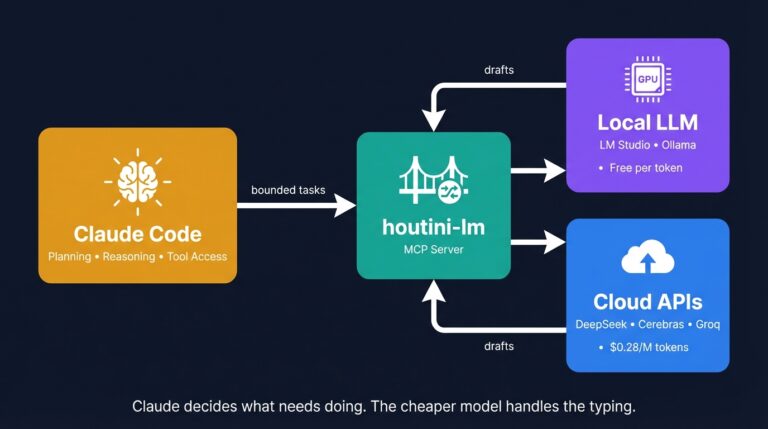
Cut Your Claude Code Token Use by Offloading Work to Cheaper Models with Houtini-LM
I built houtini-lm for people worried that their Anthropic bill might be getting out of hand. I’d leave Claude Code running overnight on big refactors, wake up, and wince at the token count. A huge chunk of that spend was going on tasks any decent coding model handles fine – boilerplate generation, code review, commit … <a title="AI SEO – A Tool to Help You Improve Your Content for AI Search" class="read-more" href="https://houtini.com/aiseo/" aria-label="Read more about AI SEO – A Tool to Help You Improve Your Content for AI Search">Read more</a>
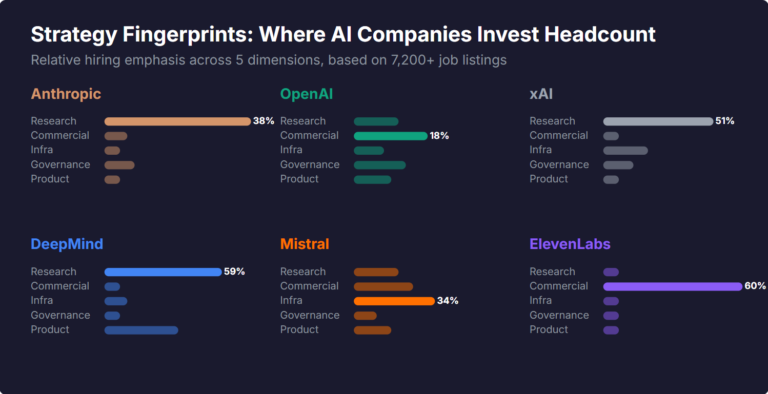
What Skills Are AI Companies Hiring For, and What Do the Jobs Tell Us About Their Strategy?
I pointed YubHub at 7,200+ job listings across the major AI labs and the hiring patterns reveal six completely different strategic bets. Anthropic is all-in on research. OpenAI reads like an enterprise SaaS company. xAI is hiring domain experts to teach Grok finance. Here's what the data shows.
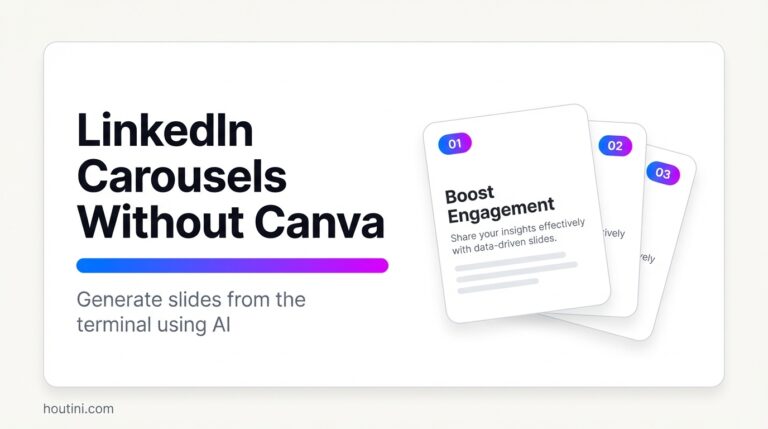
How to Create LinkedIn Carousel Slides with Gemini and Claude
A developer workflow for turning blog posts into LinkedIn carousel slides using Gemini SVG generation, Puppeteer PDF conversion, and a four-line Python merge script. No Canva, no SaaS tools.
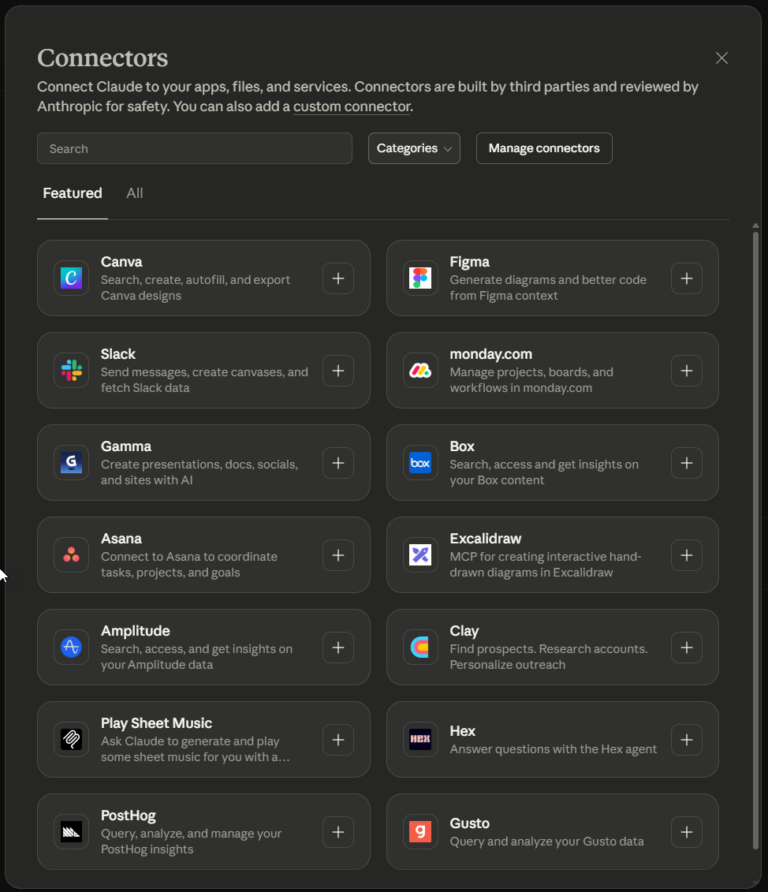
What Is an MCP Server? And, Why It Matters for AI Tool Use
My daily work literally depends on the existence of MCP servers now, spread between Claude Desktop and Claude Code. Database queries, image generation, web scraping, file management, search console data, email. Much of my daily working world lives in a conversation window. I am convinced we are at the beginning of a radical shift in … <a title="AI SEO – A Tool to Help You Improve Your Content for AI Search" class="read-more" href="https://houtini.com/aiseo/" aria-label="Read more about AI SEO – A Tool to Help You Improve Your Content for AI Search">Read more</a>
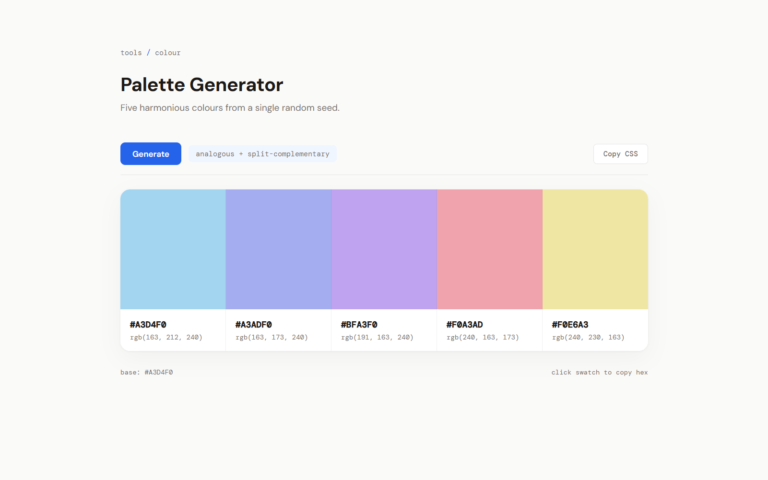
How to Improve Your AI Prototype Designs with Skills, Prompts and Gemini
I build a lot of single-file HTML prototypes with Claude Code. They work, but they all end up looking the same. I tested three approaches to fix this – Claude Skills, manual prompt engineering, and Gemini MCP feedback.