

Not all that long ago, I found myself trying to find an answer to a question about the PSU I might need for a PC accessory. I was alarmed to see that my site wasn’t in the results for the query, because that information wasn’t featured in a review I’d done about a year before.
A hard, but important lesson: Be useful, complete in your writing and have empathy for your user’s needs, or disappear.
AI isn’t a threat to good content.
As a content marketer, I look at the past year through slightly jaded eyes, “AI slop” (which is a term I don’t particularly enjoy using), felt like it was overwhelming every marketing channel we work in.
Prolific as it is, using AI to write content is not a sustainable practice. It’s a bad idea.
I’ve done the tests; AI generated content works in search for long enough to give you a false sense that everything is working well, but, if you don’t stay on top of the output or you’re lazy, your rankings will go south really quickly. In any case people instinctively know that they’re reading AI content.
You lose your brand tone of voice and start sounding like a LinkedIn post.
Creative debt.
The creative debt of having a large site littered with AI written copy is problematic too; at some point you’re going to need to rewrite it or constantly keep a close eye on what’s performing instead of focusing on growth.
Modelling natural language is tough (check out my Voice Analyser open source repo here if you’re interested).
The problem is that making writing truly feel human can’t be replicated. Your sentence rhythm, vocabulary patterns, argument flow, narrative, those micro-rhythms we weave into prose are unique and unpredictable. AI uses language in a mathematical, formulaic way – it is by its nature, measurable.
Your content people are your best asset, so in 2026 I’m focused on working with my clients to help them get more productive and streamlined.
I’m obsessed with this idea:
AI enables human productivity, it’s not a replacement for human creativity.
I own my own content sites for experimentation and revenue (of course!) so I think a lot about moving my workflows along faster, without compromising on quality. I really enjoy working with AI for content research, evaluating strengths and weaknesses of competing content, updating old content with new data, and so on.
This is where Gemini MCP is so powerful in my content workflow.
Imagine this scenario: You’ve nailed down the idea and you’re doing the research. The content research process can take a long time. This is where I might use Claude Desktop with Gemini. You can connect all manner of MCP servers to your AI assistant and get access to data or grounded insight in seconds. If you’re a large organisation, you’ll have a measure on where the time is being spent in your creative pipeline
The other focal area for us all in 2026 is of course, AI search visibility. I really enjoyed Metahan’s research on Harmonic Centrality as an authority signal in search and I recommend you read his article.
Information rich content that covers specific recommendations, nails down the key data points and, can present demonstrable first hand experience with unique observations is so important. A lot of writers (myself included) are a little guilty of vagueness in their prose. What I mean is: “pretty good”, “and so on”, “they’re reasonable” – this is not useful to AI or humans, and I think that’s a powerful takeaway.
All of us should be aware of when, and when not to use AI in our work.
Related Posts

How to Make Images with Claude and (our) Gemini MCP
My latest version of @houtini/gemini-mcp (Gemini MCP) now generates images, video, SVG and html mockups in the Claude Desktop UI with the latest version of MCP apps. But – in case you missed, you can generate images, svgs and video from claude. Just with a Google AI studio API key. Here’s how: Quick Navigation Jump … <a title="How will AI Affect Content Marketing in 2026?" class="read-more" href="https://houtini.com/how-will-ai-affecting-content-marketing-in-2026/" aria-label="Read more about How will AI Affect Content Marketing in 2026?">Read more</a>

Yet Another Memory MCP? That’s Not the Memory You’re Looking For
I was considering building my own memory system for Claude Code after some early, failed affairs with memory MCPs. In therapy we’re encouraged to think about how we think. A discussion about metacognition in a completely unrelated world sparked an idea in my working one. The Claude Code ecosystem is flooded with memory solutions. Claude-Mem, … <a title="How will AI Affect Content Marketing in 2026?" class="read-more" href="https://houtini.com/how-will-ai-affecting-content-marketing-in-2026/" aria-label="Read more about How will AI Affect Content Marketing in 2026?">Read more</a>

The Best MCPs for Content Marketing (Research, Publish, Measure)
Most front line content marketing workflow follows the same loop. Find something worth writing about, dig into what’s already ranking on your site, update or write it, run it through SEO checks, shove it into WordPress, then wait to see if anyone reads it. Just six months ago that loop was tedious tab-switching and copy-pasting. … <a title="How will AI Affect Content Marketing in 2026?" class="read-more" href="https://houtini.com/how-will-ai-affecting-content-marketing-in-2026/" aria-label="Read more about How will AI Affect Content Marketing in 2026?">Read more</a>
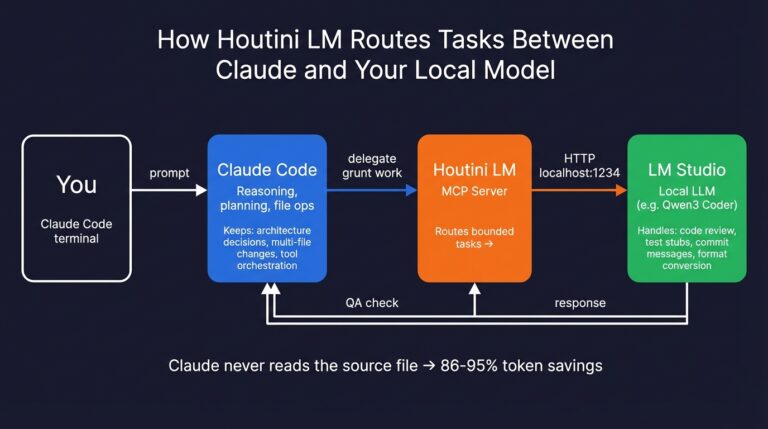
How to Set Up LM Studio: Running AI Models on Your Own Hardware
How does anyone end up running their own AI models locally? For me, it started because of a deep interest in GPUs and powerful computers. I’ve got a machine on my network called “hopper” with six NVIDIA GPUs and 256GB of RAM, and I’d been using it for various tasks already, so the idea of … <a title="How will AI Affect Content Marketing in 2026?" class="read-more" href="https://houtini.com/how-will-ai-affecting-content-marketing-in-2026/" aria-label="Read more about How will AI Affect Content Marketing in 2026?">Read more</a>
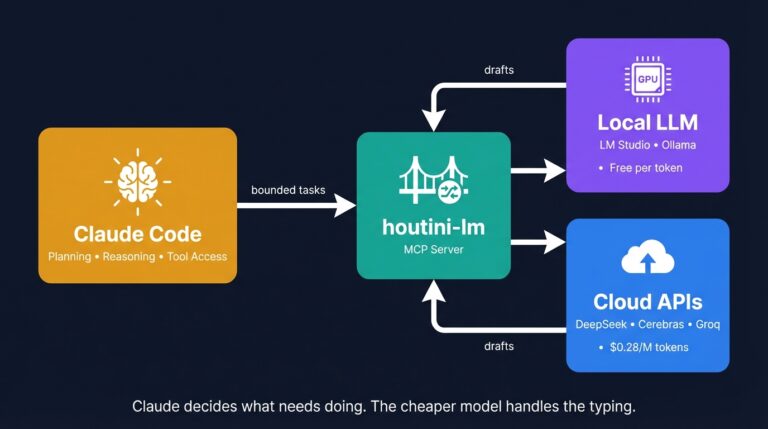
Cut Your Claude Code Token Use by Offloading Work to Cheaper Models with Houtini-LM
I built houtini-lm for people worried that their Anthropic bill might be getting out of hand. I’d leave Claude Code running overnight on big refactors, wake up, and wince at the token count. A huge chunk of that spend was going on tasks any decent coding model handles fine – boilerplate generation, code review, commit … <a title="How will AI Affect Content Marketing in 2026?" class="read-more" href="https://houtini.com/how-will-ai-affecting-content-marketing-in-2026/" aria-label="Read more about How will AI Affect Content Marketing in 2026?">Read more</a>
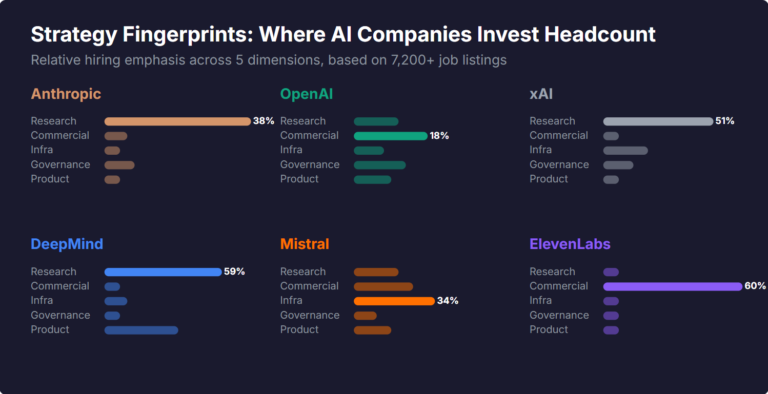
What Skills Are AI Companies Hiring For, and What Do the Jobs Tell Us About Their Strategy?
I pointed YubHub at 7,200+ job listings across the major AI labs and the hiring patterns reveal six completely different strategic bets. Anthropic is all-in on research. OpenAI reads like an enterprise SaaS company. xAI is hiring domain experts to teach Grok finance. Here's what the data shows.